
 Download Now
Better Devices Are Quietly Extending Screen Sessions
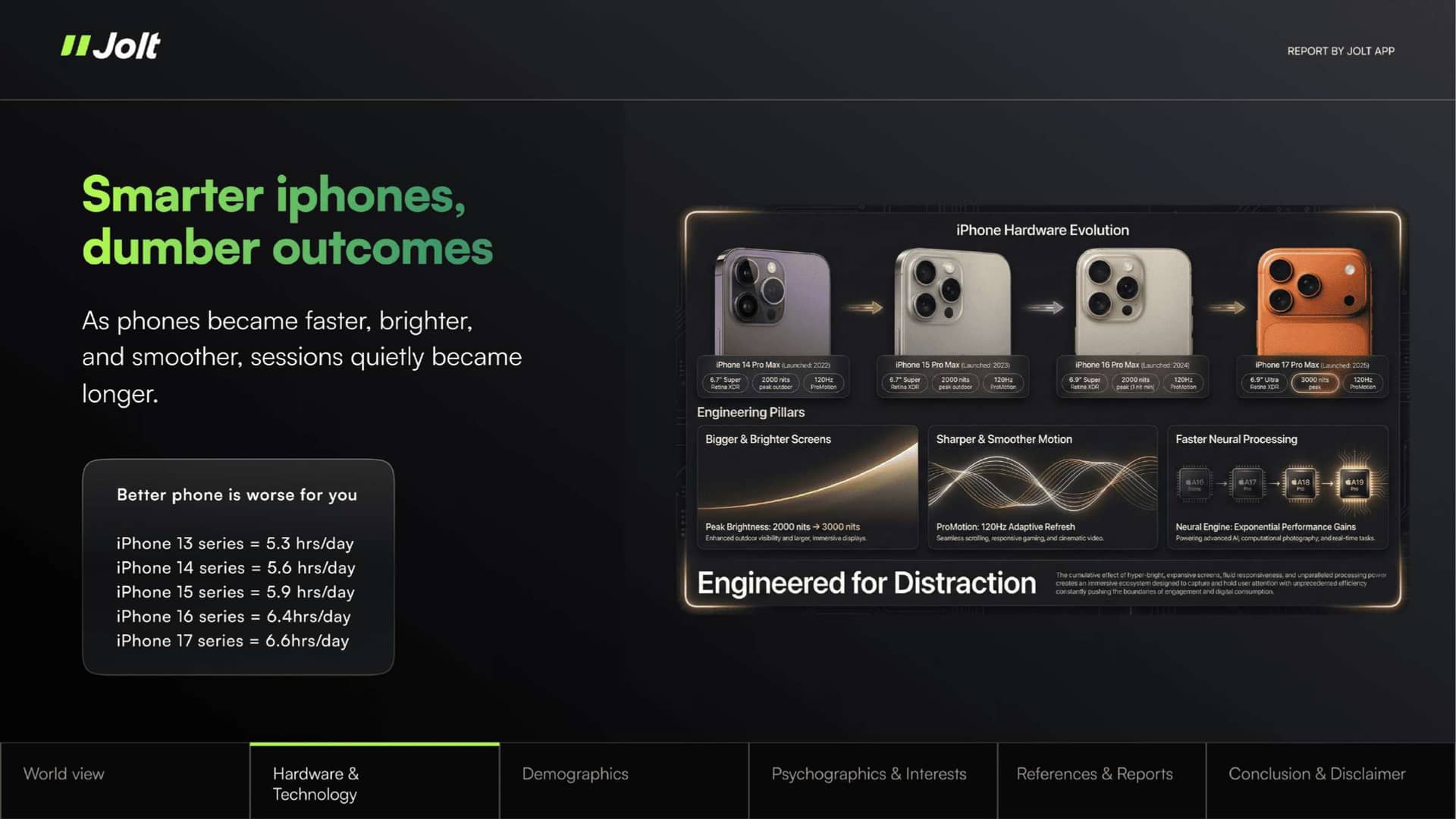
Discussions around screen time often focus on apps, habits, or self-control. The State of Human Attention 2026 highlights another, less visible factor: the role of the device itself.
Based on aggregated insights from approximately 10,000 iPhone users, the report examines how hardware characteristics align with measurable differences in daily screen exposure.
This section explores those associations in depth. It begins by examining how screen size relates to average daily usage, then looks at how improvements in brightness, motion, and processing speed correspond with longer sessions. Finally, it translates these differences into concrete time frames, showing how modest daily changes can accumulate over months and years.
Together, these findings help explain why screen exposure can remain elevated even when apps, intentions, and routines appear unchanged, and why device design plays a quiet but persistent role in shaping daily attention.
Does Larger Screen Mean More Screentime
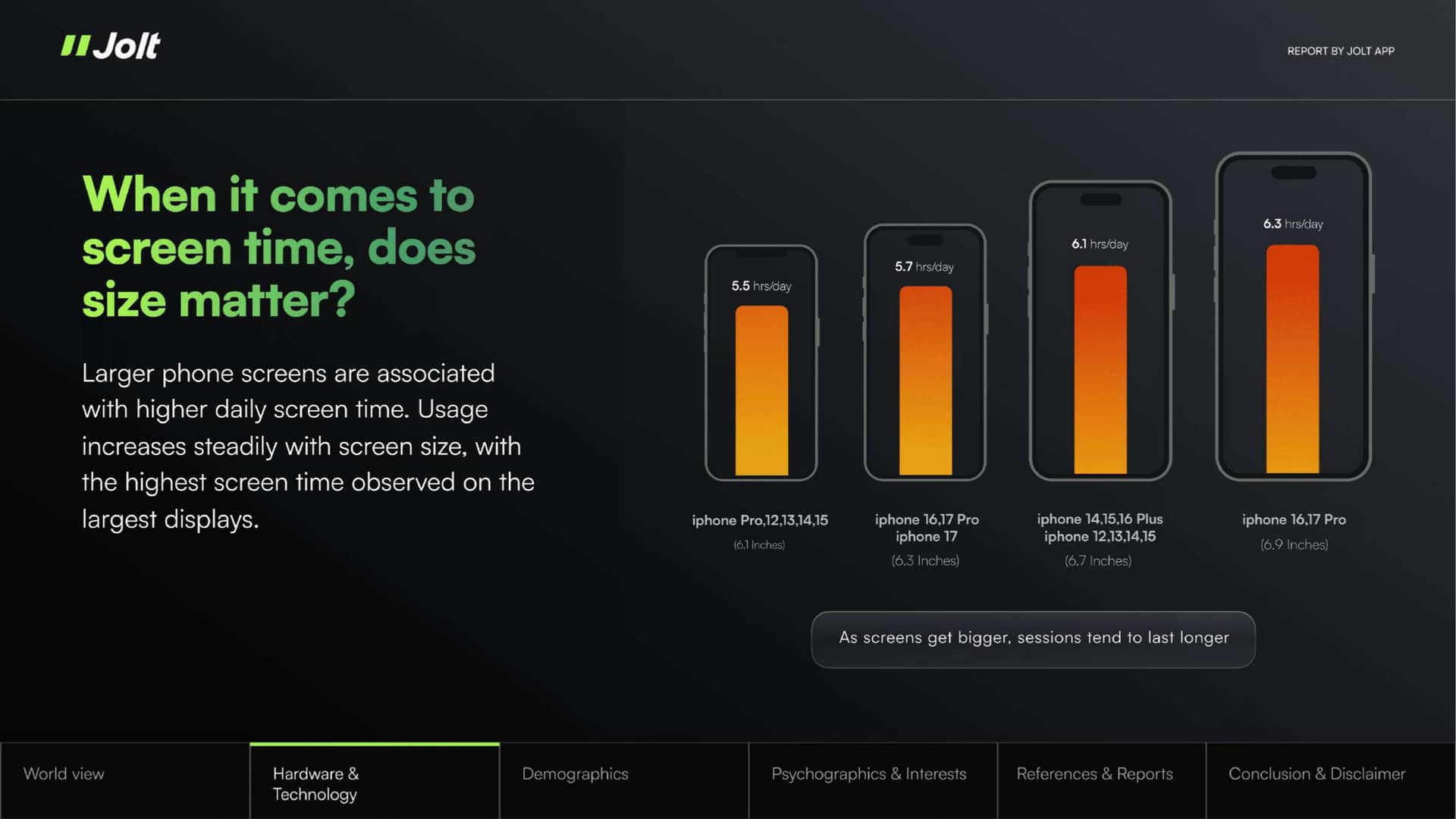
Report data of 10k iPhone users indicate a clear association: larger displays correspond with longer average daily sessions. The State of Human Attention 2026 groups devices by reported display size and finds the following average daily screen times for each group:
- iPhone Pro, 12, 13, 14, 15 (6.1 inches): 5.5 hrs/day
- iPhone 16, 17 Pro · iPhone 17 (6.3 inches): 5.7 hrs/day
- iPhone 14, 15, 16 Plus · iPhone 12, 13, 14, 15 (6.7 inches): 6.1 hrs/day
- iPhone 16, 17 Pro (6.9 inches): 6.3 hrs/day
How Brighter, Faster Phones Fuel Longer Screen Sessions
As phones become brighter, smoother, and faster, stopping becomes harder. The findings below break down how three specific hardware advances correlate with longer screen sessions by quietly removing the cues that once prompted users to disengage.
More Comfortable Viewing
Larger screens increase visual presence and reduce strain, making content easier to view for longer periods. The report shows users with bigger displays record higher average session lengths; greater legibility and outdoor readability remove a common practical limit on continuous use.
Fewer Micro-pauses, Longer Scrolls
Higher refresh rates make scrolling and animations feel effortless, removing micro-frictions that previously prompted users to stop. When navigation is fluid, brief checks more readily become prolonged browsing sessions, which raises aggregate daily exposure.
Instant Responses, Fewer Exit Points
Faster chips and optimised rendering shorten load times and eliminate pauses between interactions. These removed pauses reduce moments for reconsideration; immediate responsiveness supports continuous interaction and increases the likelihood of extended sessions.
Important Consideration
These three hardware factors are associated with longer sessions in the State of Human Attention 2026 dataset. They do not prove individual causation, but together they explain how device design can convert short checks into sustained attention.
Quantifying the Device Effect: Hours, Not Hype
Two complementary patterns appear in the State of Human Attention 2026: grouping by display size (6.1 inches to 6.9 inches) and by iPhone generation (13 to 17). Both show stepwise increases in average daily screen time.
Across display-size groups, average usage rises from 5.5 hours per day on 6.1-inch devices to 6.3 hours on the largest displays, a difference of roughly 0.8 hours per day. Across generations, average daily usage increases from 5.3 hours on iPhone 13 to 6.6 hours on iPhone 17, a 1.3-hour daily difference.
Viewed in isolation, these differences may appear incremental. Viewed alongside the broader finding that screen time has become a global baseline, they help explain why elevated daily exposure persists even without changes in individual intent or app usage.
Hardware-related gains compound on top of an already high baseline, quietly extending sessions over time.
Note: These figures describe associations observed in the dataset rather than causal outcomes for any individual user.
Your screen time won't fix itself.
Jolt blocks the apps, protects your sleep, and keeps you accountable. Free to start.
 Take charge of your time