 Download Now
Engineered by Neuroscience
Proven by Results
Backed by 20+ psychological frameworks, from habit loops to neuroplasticity,to reclaim your time, focus, and joy.








Why commitment levels work better than willpower
Willpower is a finite resource - it depletes throughout the day, is weakest at night, and fails under stress. Jolt's three blocking modes replace willpower with structure.
Mindfulness Interruption
A brief pause between impulse and action gives the prefrontal cortex time to override the habit response. Six seconds is enough. Most impulses don't survive it.
Effort Justification & Response Cost
When accessing something requires physical or cognitive effort, the brain unconsciously re-evaluates whether the reward is worth it. Most impulses don't survive 200 taps.
Ulysses Contract
A pre-commitment mechanism where you bind your future self before the temptation arrives. Named after Odysseus tying himself to the mast so he couldn't act on the Sirens' call. Research shows pre-commitment is the most reliable form of behavioral self-control.
Why tracking changes behavior before you change anything else
Self-Monitoring Theory (Carver & Scheier) shows that people who observe and record their own behavior change it - often before any other intervention. The simple act of seeing your screen time, tracking your focus score, and watching a streak grow creates a feedback loop that accelerates behavior change.
Loss Aversion
Kahneman & Tversky showed that losses feel approximately twice as painful as equivalent gains feel good. A streak at risk activates stronger motivation than a reward for completing one.
Habit Loop Cue Identification
Duhigg's Habit Loop shows all habitual behavior has a cue. Identifying the specific triggers - times, apps, contexts - that precede phone use removes the illusion that distraction is random. Without cue awareness, blocking rules are guesses. With it, they're targeted.
Awareness Precedes Change
Quantified self-knowledge is the prerequisite for behavioral intervention. Most people believe they know which apps drain them most. The data is almost always more specific - and more confronting - than the assumption.
Your screen time won't fix itself.
Jolt blocks the apps, protects your sleep, and keeps you accountable. Free to start.
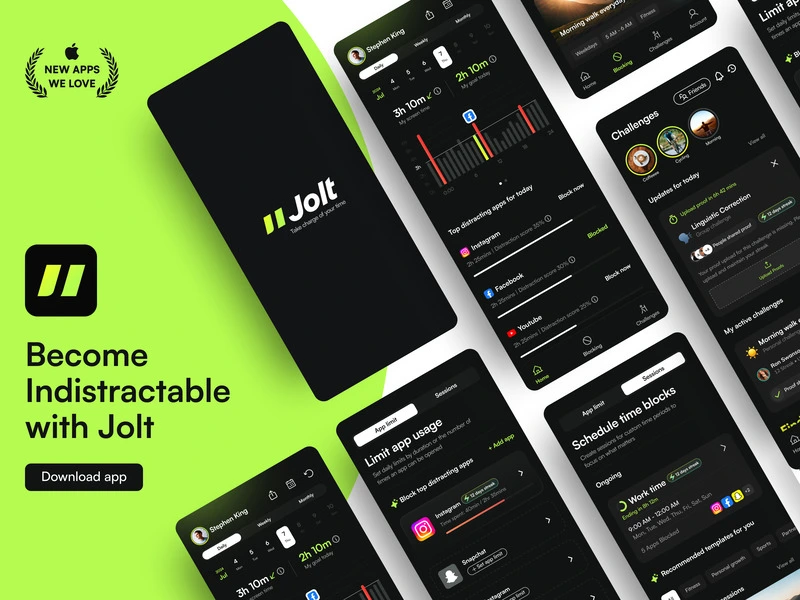
 Take charge of your time