
 Download Now
People Know What Distracts Them: Global Awareness of Distraction Across 10,000 Users
One of the most striking findings from the State of Human Attention 2026 is not what people do with their phones. It is what people know about their phones.
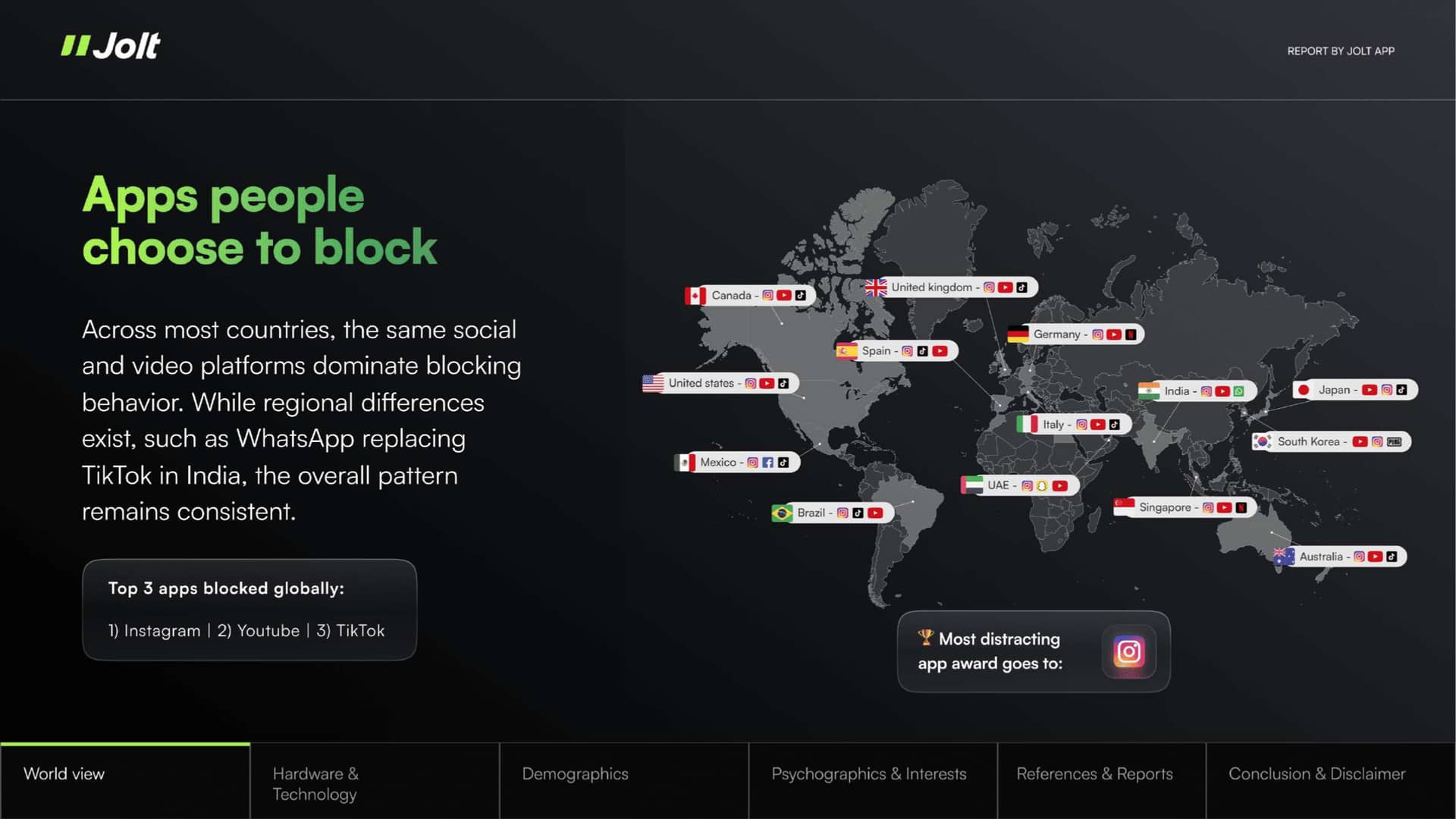
Across 10,000+ users spanning developed and emerging economies, research reveals a remarkable consensus: Instagram, YouTube, and TikTok are universally recognized as primary distraction sources. This awareness exists independent of geography, income, or profession.
Smartphone users worldwide recognize with striking clarity which platforms trigger compulsive checking, interrupt deep work, and derail their intentions. What was once assumed to be a personal weakness has revealed itself as a shared global pattern.
The research demonstrates that users are sophisticated observers of their own behavior, capable of identifying distraction sources with remarkable accuracy.
This article explores what universal awareness of distraction reveals about human attention architecture and digital intentionality.
The Global Consensus: Instagram, YouTube, TikTok
The report reveals a striking consistency in app-blocking behavior across geographies and demographics as Instagram, YouTube, and TikTok are the three most commonly blocked apps by users seeking to protect their focus.
This convergence spans continents despite wide differences in culture, infrastructure, and income. In high-income countries and emerging markets, among professionals and students, across life stages, the pattern holds.
Regional variations exist, but the core finding remains consistent: most users globally identify the same three platforms as primary attention disruptors.
Why these three?
Each platform shares a structural characteristic that creates engagement loops.
- Instagram uses infinite scroll and visual novelty.
- YouTube employs autoplay and algorithmic recommendations.
- TikTok combines short-form content with rapid-fire algorithmic personalization.
Users do not block apps randomly. They block platforms that have demonstrably interrupted their work or delayed their sleep.
The universality of this pattern reveals an important insight: distraction is not a personal weakness. It is a feature of platform design combined with predictable patterns in human cognition.
Awareness as Foundation for Intentional Behavior
What the research reveals is an often overlooked truth: people are not passive consumers of technology. They actively observe and recognize distraction sources in their lives. This awareness translates into deliberate action.
Users block Instagram not because research articles recommend it, but because they have experienced firsthand how it fragments their focus.
This level of self-knowledge is significant for two reasons:
First, it indicates that attention fragmentation is experienced and tangible
Attention fragmentation is experienced and tangible, not abstract or imagined. The global consensus on blocking patterns reflects millions of people independently arriving at the same conclusion.
Second, it reveals a critical distinction: awareness exists separate from understanding
Users know what distracts them, but understanding why reaching for these apps feels inevitable remains incomplete for most. Blocking an app is reactive management. Understanding the emotional, situational, or structural reasons is foundational for sustained behavior change.
Both matter, but they operate at different levels.
Regional Patterns and Stability Across Age Groups
While Instagram, YouTube, and TikTok dominate globally, the research reveals regional refinements. WhatsApp ranks higher in certain markets where work communication norms create constant notification streams. Reddit and news apps appear more frequently among specific professions.
Across age groups, the awareness pattern remains stable. Students (13-22), young professionals (23-32), mid-career professionals (33-44), and senior users (45+) all identify Instagram and YouTube as distraction sources.
What changes is the context. Students struggle with social comparison during study. Professionals struggle during focused work. Despite different contexts, the apps remain constant distraction sources across demographics.
This consistency suggests that these apps have engineered user experiences that appeal to fundamental human drives across life stages and cultures.
Design Implications and User Agency
The State of Human Attention 2026 reveals users are building workarounds within existing systems because they want autonomy to shape their digital experience.
This signals a design insight: when millions of people independently take the same action, it indicates a shared need. Users do not want elimination. They want control. They want boundaries, not banishment.
The future of digital wellness lies in building systems through blocking feature where intentional use becomes easier and more rewarding than reflexive use.
What Awareness Means for Sustained Change
The State of Human Attention 2026 demonstrates that people know what distracts them. This universal awareness is not a weakness. It is the foundation upon which intentional digital living is built.
Awareness is essential but not sufficient. It is the starting point. The next question is how systems, tools, and environments translate that awareness into sustained behavior change.
Your screen time won't fix itself.
Jolt blocks the apps, protects your sleep, and keeps you accountable. Free to start.
 Take charge of your time