
 Download Now
When Rest Turns Into Scrolling
Screen time is not evenly distributed across the day. According to the State of Human Attention 2026 report, it clusters in five specific moments: breaks, mornings, bedtime, waiting, and commuting.
These moments account for a large share of daily screen exposure across all age groups and professional backgrounds.
These are not random interruptions but systematic colonization of transition moments that historically allowed nervous system recovery.
When a break becomes scrolling, what should be restoration becomes continuation of cognitive load, creating what recent research terms the restoration gap.
This gap explains a critical finding across all ages and professions: people feel more exhausted after taking phone breaks than if they had worked through.
Understanding why transition moments have become screen-time defaults is essential to understanding why modern fatigue persists despite increased leisure time.
The Five Sacred Moments: From Recovery Windows to Screen-Time Hotspots
Breaks from work, morning routines, bedtime wind-downs, waiting periods, and commuting were historically unstructured recovery phases.
Each served specific neurological functions:
- Breaks allowed attention systems to reset.
- Mornings enabled easing into the day.
- Bedtime supported downregulation toward sleep.
- Waiting provided space for observation and social connection.
- Commuting offered mental decompression between contexts.
Today, reflexive phone use has replaced these functions across all age groups and geographies.
The moment of transition itself has become the trigger for scrolling, not a decision but an automatic response.
Relief Masquerades as Recovery: The Neurological Distinction
The restoration gap exists because relief and recovery operate through different biological pathways.
When scrolling stops, dopamine declines, creating a biochemical sense of calm. This is relief. Relief feels like rest to the conscious mind, but the parasympathetic nervous system, which drives actual recovery, remains dormant.
True recovery requires slower heart rate, deeper breathing, and safety signals the body recognizes. A dopamine drop provides none of these. Sympathetic activation (fight-or-flight) persists at low levels.
Over time, repeated incomplete recovery builds allostatic load, the cumulative physiological cost of unresolved stress. The result: exhaustion despite frequent "breaks."
This mechanism explains why people taking phone breaks report feeling worse rather than restored. The nervous system never completes its downregulation cycle.
Three Stages of Takeover: Boredom, Stress, and Habit
Phone use in transition moments follows a predictable three-stage pattern across life stages.
Boredom initiates
In adolescence and early adulthood, where idle moments trigger discomfort that scrolling immediately alleviates.
Stress sustains
In young and mid-career professionals, where the phone becomes a rapid escape from work pressure.
Habit maintains
In later life stages, where the behavior persists even as triggering stressors decline.
This progression explains why blocking specific apps fails. The underlying drivers shift with life stage, not app availability.
A professional experiencing work stress will simply replace Instagram with email or news if Instagram is blocked, maintaining sympathetic activation without achieving recovery.
The Algorithm's Re-Entry Prevention Mechanism
Beyond personal drivers, algorithmic design actively prevents recovery completion.
Algorithms detect declining engagement during breaks and refresh feeds with content engineered to reignite curiosity before nervous system downregulation can occur.
This re-entry loop restarts activation precisely when it should be ending. The person remains in low-level arousal throughout the day, with no genuine recovery window.
Life-Stage Variation and Intervention Leverage
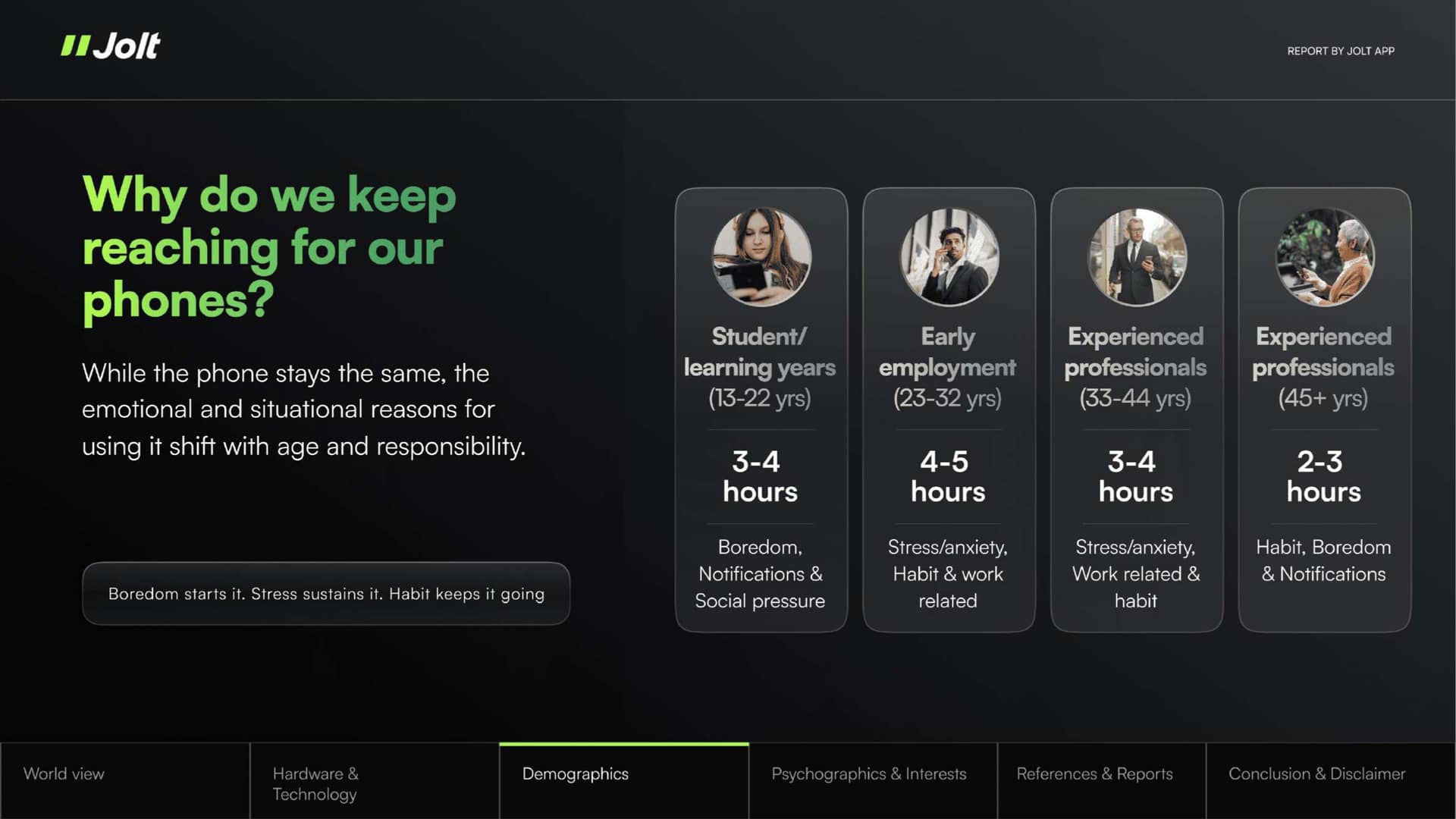
While the five transition moments are consistent across ages, the emotional engines powering scrolling shift significantly.
- Students scroll from boredom.
- Young professionals scroll from stress.
- Mid-career professionals continue from habit.
- Senior professionals scroll from notification fatigue.
Understanding which driver is active enables targeted intervention. The leverage point is structural redesign of these moments, not app blocking.
Creating intentional friction makes phones less the automatic default, allowing restorative alternatives to fill the space. This is recovery reclaimed.
Transition Moments are where Recovery happens, or where It's lost
Reclaiming transition moments is not about eliminating technology but making its use intentional rather than reflexive. When these five moments return to their original function as recovery time, the entire day's capacity for focus, sleep quality, and stress resilience shifts fundamentally.
This is where sustained behavior change begins.
Your screen time won't fix itself.
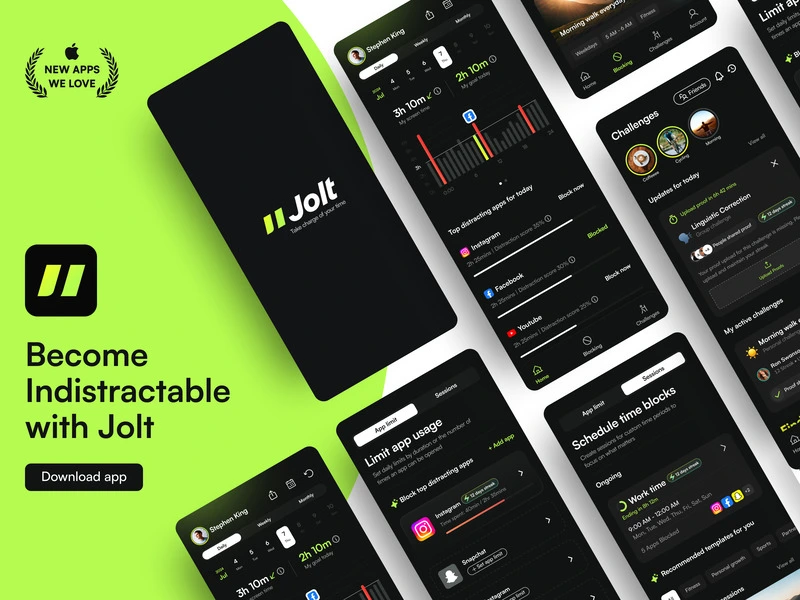
Jolt blocks the apps, protects your sleep, and keeps you accountable. Free to start.
 Take charge of your time