
 Download Now
It's Not a Teen Problem, It's an Adulthood Pattern
High screen time is often framed as a teenage issue, something people naturally leave behind as responsibilities increase and priorities settle. The pattern described in this section challenges that assumption.
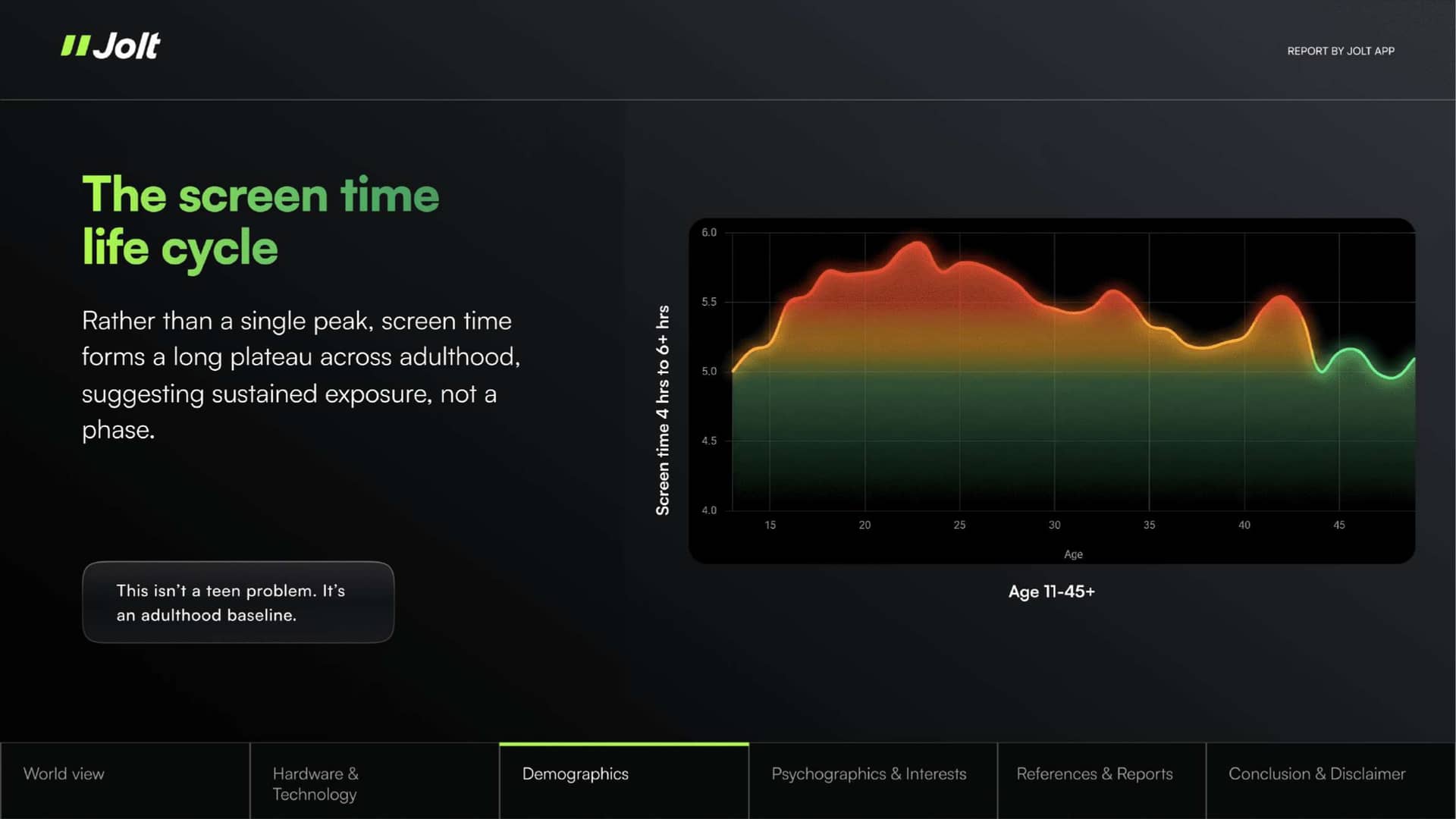
Across adulthood, screen use does not meaningfully decline. Instead, it stabilizes at a high level and evolves in form. What begins as socially driven scrolling in younger years gradually shifts into work-related use, stress regulation, habitual checking, and utility-oriented consumption. The device remains constant, but the role it plays in daily life changes.
This section examines why screen time persists well beyond adolescence, how it becomes structurally embedded into adult responsibilities, and what sustained exposure across decades may imply for attention and development. It also illustrates this progression through a representative lifecycle narrative.
For the full dataset, methodology, and global context behind these findings, refer to the State of Human Attention 2026 report.
Maturity Doesn't Remove Screens; It Changes Intent
Across adulthood, daily screen time remains consistently high. What changes is not the duration of use, but its context. As people move through different life stages, screen use shifts from socially driven behavior toward work-related demands, stress regulation, habitual checking, and utility-based tasks.
This pattern challenges the idea of "outgrowing" phone use. The persistence of high screen time indicates that it is not simply a matter of self-control or age. Instead, it reflects how modern adult life is structured around digital systems for communication, coordination, and relief from cognitive load. Maturity changes the purpose of screen use, not its presence.
Why Screen Use Becomes Structural in Adulthood
High screen time persists across adulthood because screens are now embedded in how adult life functions. The State of Human Attention 2026 shows that work, communication, coordination, and daily information access increasingly rely on digital interfaces, making screen use a structural requirement rather than an optional behavior.
In professional contexts, screens are central to email, messaging, document collaboration, meetings, and task management. Even moderate workloads accumulate substantial screen exposure over the day. Outside of work, the same devices support essential activities such as communication, navigation, news consumption, and entertainment. These use-cases compound rather than replace one another.
The report's findings indicate that screen time does not compete with adult responsibilities. It becomes the medium through which those responsibilities are managed. This integration explains why screen time remains elevated across adulthood, independent of motivation or maturity. The plateau persists not because of poor self-control, but because modern adult life is increasingly organized around screens.
What Prolonged Screen Exposure Across Ages 11–45+ Means for Attention and Development
Sustained exposure, not a temporary phase
The screen-time plateau observed in the data reflects sustained exposure across multiple life stages, from early adolescence into full adulthood. This is not a short-lived behavioral phase, but a persistent condition that spans formative developmental years and mature adult life. As a result, screens are not intermittently shaping behavior, but continuously present throughout cognitive and emotional development.
Attention and reward systems over time
Patterns in the research suggest that prolonged exposure to high-interruption digital environments may influence how attention is allocated over time. Long-term interaction with fast-paced, algorithmically optimized content may gradually recalibrate reward sensitivity and baseline arousal, potentially making sustained focus and deep engagement more difficult to maintain.
Recovery, sleep, and relational patterns
Sustained screen use also intersects with recovery processes. Regular evening exposure can compound over years, contributing to persistent disruption of rest and sleep cycles. Over time, relationships and communication patterns may also become increasingly mediated by screens rather than direct interaction.
Important Consideration
The State of Human Attention does not measure these long-term outcomes directly. However, the persistence of high screen exposure suggests it is a defining condition of the modern lifespan rather than a temporary influence.
From Social Scrolling to Deliberate Viewing: A Lifecycle View of Screen Use
To understand how screen use evolves across adulthood, consider the digital lifecycle of a representative user, Alex.
At 19
Alex's screen time is socially driven. Short-form platforms dominate, and phone use is shaped by boredom, notifications, and the need to stay connected. Screens fill idle moments and smooth social gaps rather than serving a specific functional purpose.
By his late twenties
The pattern shifted. Social pressure recedes, but daily screen time remains high. Work demands, stress, and habitual checking become the primary drivers. Short clips give way to longer videos, news, and utility-based content, often used as a way to decompress after cognitively demanding days. For a deeper look at this transition, see Work Has Become a Major Driver of Screen Exposure.
By mid-adulthood
Alex uses his phone more selectively. Social apps may be reduced, yet total screen exposure stays elevated through long-form content, information access, and routine digital coordination.
Across life stages, the device stays the same. What changes is intent. Screen time does not fade with maturity; it becomes more deliberate.
Your screen time won't fix itself.
Jolt blocks the apps, protects your sleep, and keeps you accountable. Free to start.

 Take charge of your time