
 Download Now
Screen Time Has Become a Global Baseline: Why 5 Hours 37 Minutes Is Now Standard
Average daily screen time now stands at 5 hours and 37 minutes worldwide, with multiple countries crossing 7+ hours per day. What was once considered heavy or exceptional use has quietly become the norm.
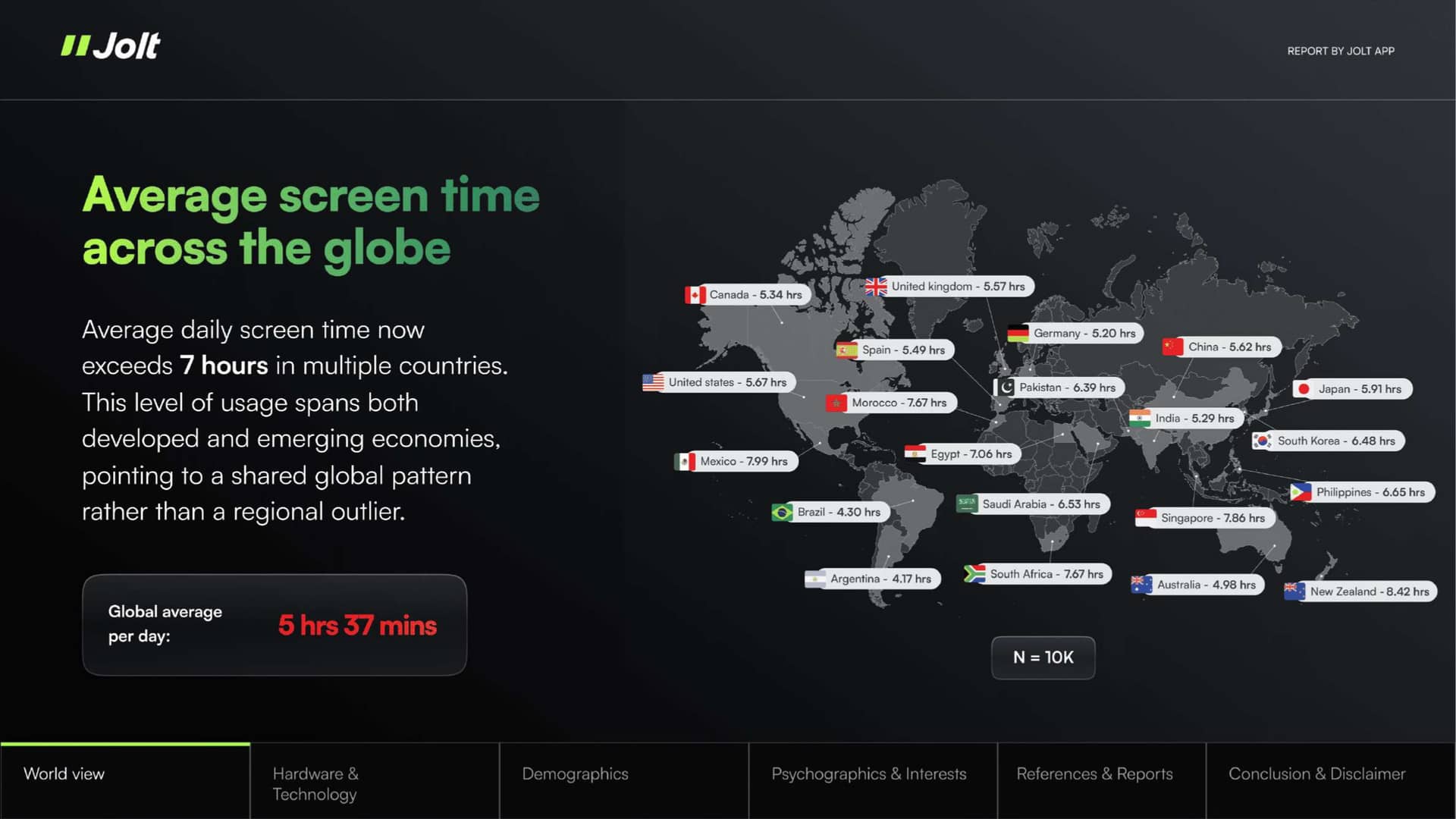
This shift is no longer limited to a small group of power users or a handful of digitally advanced regions. Across both developed and emerging economies, daily screen exposure has converged toward a shared baseline. In practical terms, spending several hours a day on screens is now a median reality for large parts of the global population.
This section examines what the global data reveals, how to interpret the convergence across countries, and why this shift matters for attention, health, and policy. For full charts, country-level comparisons, and methodology, refer to the State of Human Attention 2026 report.
Beyond Borders: High Daily Screen Time Is a Worldwide Norm
Report data show a clear convergence: elevated daily screen time is no longer isolated to a handful of digitally advanced markets. Several countries now average 7+ hours per day (for example: Mexico, New Zealand, Singapore), and many more cluster near that level, a pattern that spans Asia, the Middle East, Europe, the Americas and Oceania despite wide differences in culture, infrastructure, and income.
This geographic clustering points to structural drivers rather than local quirks. Digital workflows, always-on messaging, global streaming platforms, and improved device and network access have become common conditions of daily life.
What a baseline of 5–7 hours actually displaces
A daily screen-time baseline of roughly 5 to 7 hours removes a substantial portion of everyday waking life. At the observed global average of 5 hours 37 minutes, screen use occupies about one third of a typical 16-hour waking day. Over the course of a year this amounts to roughly 2,050 hours, or about 85 days of continuous time. Framed this way, the question is not only how much time people spend on screens but what that time would otherwise support.
Much of those hours commonly substitute for activities that protect attention and wellbeing: sustained, uninterrupted work; regular physical activity; evening recovery and sleep; and in-person social time. The State of Human Attention report highlights the practical risk: the central concern is not merely increasing minutes, but the goods those minutes replace focus, rest and recovery.
Why Screen Habits Converge Across Countries
Screen habits converge across countries because people respond to the same underlying triggers, even in very different cultural and social contexts. Findings from the State of Human Attention Report 2026 show that boredom, stress, notifications, and habit consistently drive phone use worldwide, although their relative prominence varies by region.
Regional patterns show that people across countries turn to screens for largely the same reasons. In parts of Asia, boredom and notification-driven checks are most common. In the Americas and Oceania, stress and habitual use dominate, often reinforced by work-related connectivity. Across Europe, habit and boredom consistently lead. While the emphasis varies by region, the underlying emotional and situational triggers remain the same.
Because these drivers are shared, cultural and economic differences shape how screens are used rather than how much they are used. As digital routines and infrastructures become universal, daily screen exposure naturally converges across countries.
Also explore how work has become a major driver of screen exposure.
What leaders, designers, and individuals can actually do
The evidence points to a clear conclusion: sustained screen time is shaped more by environment than by individual willpower. Attention outcomes improve when contexts are designed to protect recovery, focus, and re-engagement rather than relying solely on self-control.
For leaders and organisations
The strongest lever is norm-setting. Teams that perform well tend to limit unnecessary meetings, reduce after-hours communication expectations, and create psychological safety around disconnecting. Fewer interruptions make deep work and recovery more attainable within the same time budget.
For product and system designers
Small amounts of friction matter. Defaults that slow non-essential use, introduce natural stopping points, or limit infinite consumption can materially reduce prolonged sessions without harming utility.
At the individual level
Progress comes from setting realistic targets rather than extremes. Aiming for a sustainable range, such as 3 to 5 hours per day, and using tools that make usage visible and intentional, including apps like Jolt, helps align daily behavior with attention goals.
The common thread is design. When environments support focus and recovery, healthier screen habits follow.
Your screen time won't fix itself.
Jolt blocks the apps, protects your sleep, and keeps you accountable. Free to start.
 Take charge of your time