Does Blue Light From Screens Affect Sleep?
Yes. Blue light delays your body's release of melatonin and can shift your internal clock by up to three hours. But that is not the reason most people are still awake at 1 a.m. The deeper reason is that avoiding screens before bed is a decision you have to make every single night, and most nights, you do not make it.
This article covers what blue light actually does to your sleep, why the standard advice (filters, night mode, “just put the phone down”) does not hold for most people, and what actually closes the gap.
What Does Blue Light Do to Melatonin?
Melatonin is the hormone that tells your body it is time to sleep. It normally starts rising a couple of hours before your usual bedtime. Light, especially blue light in the 460 to 480 nanometer range, tells your brain it is still daytime and delays that rise.
A Harvard Medical School study tested this directly: researchers exposed people to 6.5 hours of blue light and compared it to 6.5 hours of green light at the same brightness. Blue light suppressed melatonin for about twice as long as green light and shifted circadian rhythms by twice as much: 3 hours versus 1.5 hours (
Harvard Health, “Blue light has a dark side”). That study used a controlled light box, not a phone screen, so treat the 3-hour figure as what continuous, concentrated blue light can do, not a promise about what one hour of scrolling does to you specifically.
Light does not need to be blue to cause problems. A 2011 study found that ordinary room light before bedtime (well below the brightness of daylight) suppressed melatonin by more than 50% in most people tested, before a screen was even involved (
Gooley et al., Journal of Clinical Investigation). A phone screen held close to your face at night adds concentrated light on top of that baseline.
There is also a newer, more precise finding worth knowing: a 2023 study found that overall light intensity as your eye's non-visual receptors register it, not the blue wavelength specifically, may be the better predictor of how much a screen disrupts your sleep (
Communications Biology, 2023). This matters in practice: turning your screen warmer (night mode) helps less than turning it dimmer.
Why Doesn't the Standard Advice Work?
You already know the advice: use night mode, dim your screen, stop scrolling an hour before bed. Most people know it and do it anyway. The problem is not information. It is that every one of these fixes depends on you deciding, in the moment, to follow a rule you set for yourself hours earlier.
Night mode does not stop you from opening the app. Dimming your screen does not stop you from picking it up at 11 p.m. because a notification came in. A rule you can override in one tap costs you nothing to break, so most nights, you break it. That is not a willpower problem. It is a design problem: nothing in the phone actually enforces the boundary you set.
What Reduces Blue Light's Effect on Sleep?
These reduce exposure. They do not remove the need to actually stop using the phone.
- Turn on night mode or a blue light filter. iPhone's Night Shift and Android's Night Light shift the screen toward warmer tones. This helps, but the 2023 finding above means brightness matters more than color, so pair it with the next step.
- Lower your screen brightness in the evening. A warm-toned screen at full brightness still delivers enough light to matter.
- Set a real cutoff before bed, not a suggestion. An hour with no screen before sleep gives melatonin room to rise on its own.
- Switch to warm lamps instead of overhead white light in the hour before bed. The 2011 room-light study above found this matters even without a screen in the room.
- Turn off notifications after a set time. A notification is what actually pulls you back to the phone, more often than boredom does.
Blue-light-blocking glasses are a common suggestion. The evidence is mixed: a study on schoolboys found the glasses shifted when they fell asleep, but did not actually change their measured melatonin levels (
study cited in Comparative Effects of Red and Blue LED Light). Treat glasses as a possible help, not a fix.
Where Native Phone Tools Stop Working
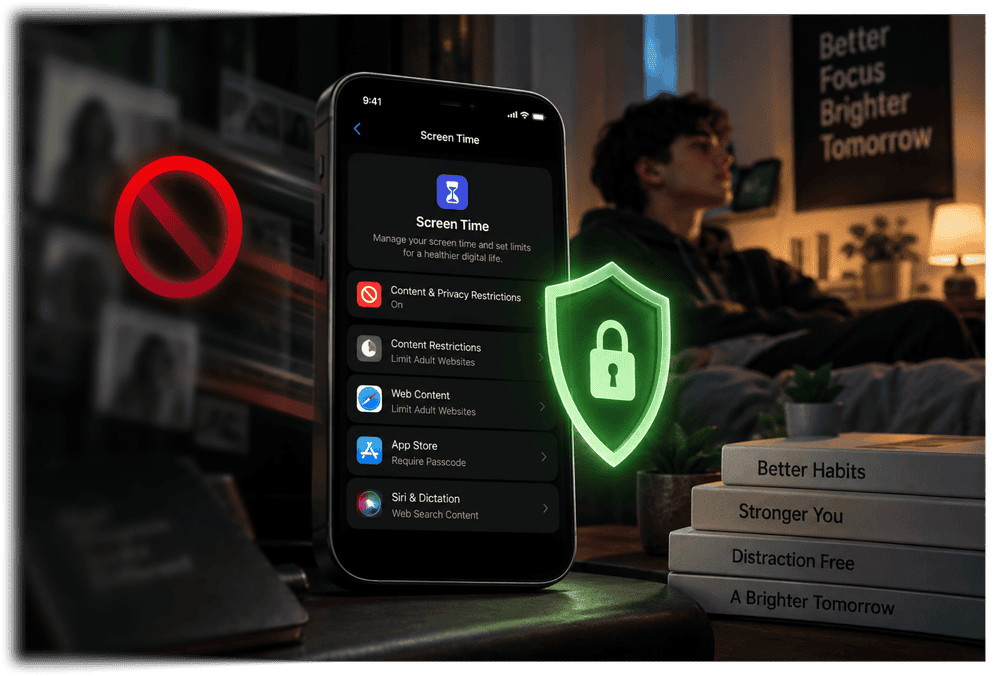
iPhone's Screen Time and Android's Digital Wellbeing both let you schedule a bedtime block. Both also let you turn it off the moment you want to check one more thing, no explanation required. That gap, between a limit that exists and a limit that holds, is where most nighttime screen use actually happens.
This is what Jolt's Sleep Schedule is built to close. You set a bedtime and a wake time once, and Jolt applies it automatically every night. A wind-down window of 15-, 30-, or 60-minutes runs before bed and a morning window runs after you wake, each set to one of three strictness levels: Gentle Reminder, which nudges you but leaves apps accessible, Gradual Block, which allows a snooze, or Full Block, which locks your chosen apps for the whole window with no override. Jolt also tracks your Last Scroll (the final pickup before you fall asleep) and First Pickup (how fast you reach for your phone after waking), and rolls both into a nightly Sleep Score so you can see whether the window is actually holding, not just whether you set it up once.
The difference from Screen Time or Digital Wellbeing is not the schedule. It is that Full Block mode does not unlock until morning, even if you want it to at 1 a.m.
FAQ
Does blue light really suppress melatonin?
Yes. Research going back over a decade shows blue light delays and reduces melatonin release more than other wavelengths, though recent findings suggest overall light intensity plays a large role too, not color alone.
Do blue light filters or night mode actually help me sleep?
They reduce blue wavelength exposure, but evidence suggests screen brightness matters as much or more. Use a filter and lower your brightness together, rather than relying on the filter alone.
Do blue-light-blocking glasses work?
The evidence is mixed. Some studies show they shift sleep timing earlier; at least one recent study found no change in actual melatonin levels. They are worth trying, not worth relying on.
How long before bed should I stop using screens?
An hour is a reasonable, evidence-informed target. The exact number matters less than whether the cutoff actually holds every night, which is the harder problem.
What is different about Jolt's Sleep Schedule versus my phone's built-in bedtime mode?
Built-in tools let you override the block in the moment. Jolt's Full Block mode does not unlock until your set wake time, so the limit holds on the nights you would otherwise talk yourself out of it.
If falling asleep on your own terms keeps not happening, Jolt's Sleep Schedule sets the boundary once and holds it every night.
Try Jolt on the App Store →
 Download Now
 Take charge of your time