Technoference: The Real Reason Phones Are Quietly Wearing Down Relationships
You're sitting with your partner. The TV is murmuring in the background. Both of you are scrolling. You're a foot apart and somehow nowhere near each other.
MIT sociologist Sherry Turkle has a name for this: being “alone together”, physically present, emotionally somewhere else entirely. It's a strange, modern kind of distance, and researchers have spent the last several years trying to measure exactly how much damage it does.
The answer, it turns out, isn't really about how much time couples spend on their phones in general. It's about when, and understanding that distinction is where building a good relationship with your partner actually starts, long before any conversation about "screen time rules."
It's Not Total Screen Time — It's Phone Use Around Your Partner
A 2025 study published in
Human Behavior and Emerging Technologies did something most research on this topic hadn't: instead of asking couples to estimate their own phone habits, researchers tracked 247 adults' actual smartphone use over eight days, alongside nightly diaries about time spent with their partner. On average, people were on their phones during roughly a quarter of the time they spent with their partner, and 86% used their phone at least some amount every single day while together.
The key finding wasn't about volume, it was about timing. Total daily phone use didn't meaningfully predict relationship satisfaction. Phone use specifically during time with the partner did. Researchers call this pattern technoference: everyday interruptions where a device pulls attention away from a partner in the moment they're supposed to have it.
This reframes the usual advice. "Spend less time on your phone" misses the point. The couples who struggle most aren't necessarily the ones with the highest total screen time, they're the ones whose phone use bleeds into the hours meant for each other.
What Happens When You Get "Phubbed"
The specific act of being ignored in favor of a phone has its own body of research under the term
phubbing (phone snubbing). A 2025–2026 study out of the University of Connecticut and Columbia University, published in the
Journal of Social and Personal Relationships, found that being phubbed by a partner made people feel less loved and less cared for, which in turn lowered overall relationship satisfaction. A separate 2025 meta-analysis in
Frontiers in Psychology pooled multiple studies and confirmed the same pattern holds across marital and romantic relationships broadly, not just in one sample.
How common is this? Recent survey data puts it in concrete terms: roughly 4 in 10 Americans in a relationship say they're bothered by how much time their partner spends on their phone. That's not a fringe complaint, it's a majority-adjacent experience.
The mechanism that researchers have found is rather simple, if considering it from the correct perspective. Since the researchers have dubbed it ‘phubbing,’ it is rather evident that the act itself is not what hurts the relationship. Instead, it is the conflict that the couple experiences about phone usage that leads to a decrease in relationship satisfaction over time. This being the case, the main way of countering the problem is not removing phones from the relationship but instead mitigating the situations when they become a source of conflict.
The Comparison Trap: When Someone Else's Feed Becomes the Standard
There is another, less blatant channel through which social media usage affects the couple negatively. A person, in the process of interacting with a social media network, can subconsciously measure themselves against others. Many studies analyzing social comparison and its effects on the relationships show that the higher engagement in social media equals increased levels of jealousy and worse quality of relationships. This negative change only occurs because of the comparison; if it were not for the process of measuring oneself against others, there would be nothing affecting the relationships directly.
The practical takeaway isn't "quit social media." It's noticing when scrolling starts functioning as a measuring stick for your own relationship, and naming that out loud instead of letting it quietly reset your expectations.
Rebuilding the Moments That Actually Matter
Given that timing - not total amount - determines satisfaction, interventions should be targeted and specific rather than broad, as these have greater impact. They were found to be effective regardless of whether newlyweds or "empty nesters" were surveyed, the advice on maintaining a happy marriage was largely similar to what a young couple would get for dating advice, since the mechanism didn't change:
Protect the transition moments. Technoference research points to specific windows, mealtimes, the first ten minutes after someone gets home, and the last twenty minutes before sleep, as disproportionately damaging when phones intrude on them. These are short, high-leverage windows, not full evenings.
Name it instead of negotiating it silently. Studies on phubbing find that couples who explicitly discuss phone expectations, rather than each partner independently deciding what's acceptable, report better outcomes. A five-minute conversation about "phones down during dinner" does more than either partner unilaterally trying to change their own habits.
Replace, don't just remove. A no-phone rule without something to fill the space tends to fail quietly. Simple substitutes, a shared morning check-in, a weekly screen-free activity, a specific bedtime ritual, give the freed-up attention somewhere to go instead of just leaving a gap.
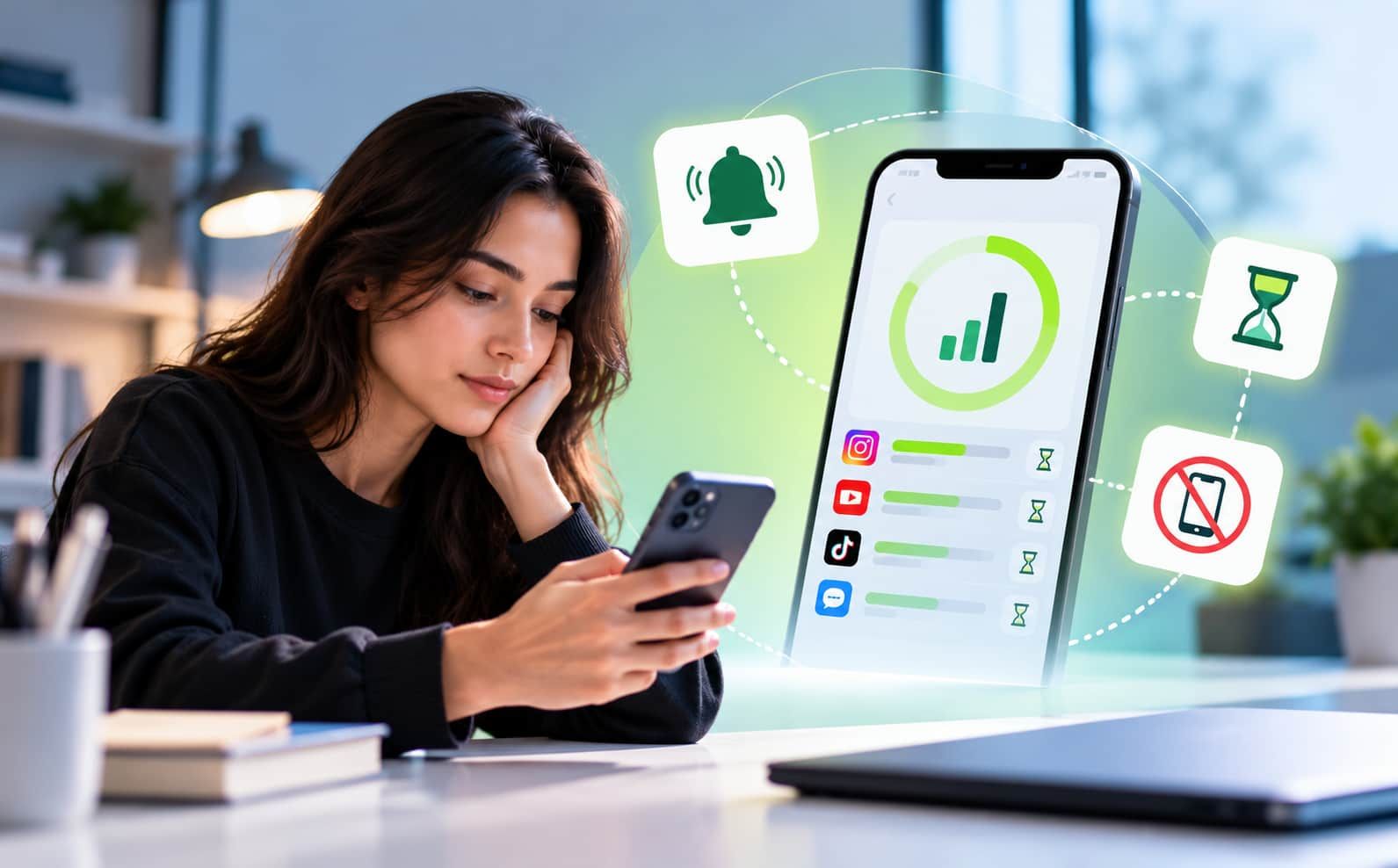
Use scheduling instead of willpower for the hardest windows. For the specific moments identified above, dinner, arrival-home, and pre-sleep, a tool that pauses notifications or blocks distracting apps automatically removes the need to negotiate it in the moment.
Jolt's session limits let you schedule exactly these windows so the phone isn't part of the decision at all once the time arrives, and its Social Media Detox mode is built specifically around the kind of passive, comparison-driving scrolling described above.
A Few Reflection Prompts Worth Actually Using
Technoference research suggests that awareness alone shifts behavior somewhat, simply naming the pattern out loud changes it. A few questions worth asking each other periodically, not as a formal exercise, just in conversation:
- Which specific moments this week did a phone interrupt something that mattered?
- Is there a window, dinner, first ten minutes home, bedtime, worth protecting on purpose?
- When did we last do something together with no phones involved at all?
None of this means ditching your phones in the relationship, which is both unrealistic and not what the researchers found. They actually found that narrowing the focus to a few crucial areas in which technology use should be limited had a bigger impact on relationship satisfaction than any general restriction.
Frequently Asked Questions
Does it matter how much total time my partner spends on their phone?
Less than you might think. Studies that tracked actual phone usage found that overall phone use didn't affect the relationship, it was the phone usage during time spent together that did. Someone who's on their phone constantly but is attentive and present when they're not on it is much different than someone who's constantly checking their phone during a shared activity like dinner.
What exactly is "phubbing"?
It's short for “phone snubbing”, ignoring a partner in favor of phone use in the moment. It's been studied specifically because it's a distinct behavior from general phone use; it's the in-the-moment choice to attend to a device instead of a partner that the research links to lower satisfaction.
Is scrolling social media together actually a problem if we're not on our phones separately?
It can still create distance even when you're physically side by side, since each person is mentally in a separate feed. Beyond that, heavy social media use on its own has been linked to increased jealousy and comparison, which is a separate mechanism from simply being distracted.
Is this just a problem for younger couples?
No, the research spans newlyweds to long-married couples and even looks at coparenting quality, not just romantic satisfaction. Technoference during shared time affects relationship quality regardless of relationship length.
What's the one change that matters most, based on the research?
Protecting a small number of specific, recurring windows, meals, the first minutes after reuniting, and the time right before sleep, rather than trying to overhaul phone habits generally. Narrow and consistent beats broad and unsustainable.
How do you keep a relationship strong with a boyfriend or girlfriend in the early stages, when texting and social media are a bigger part of daily contact?
Early relationships are conducted almost exclusively behind a screen anyway, so the same advice applies: that there should be some face-to-face time to supplement the texting, rather than the other way around. Relationships thrive on face-to-face contact, not screens, so even if the relationship is conducted almost exclusively through screens anyway, it is a good idea to make an effort to spend some time together, for the sake of relationship longevity.

 Download Now
 Take charge of your time



 Twinkle