How to Block Mind-Reading Technology: Protect Your Thoughts?
The idea of mind-reading technology often sounds frightening. Many people search how to block mind-reading technology because they worry that their thoughts are no longer private. News about artificial intelligence, brain chips, and surveillance systems can make it feel like technology is moving faster than human control.
Before talking about protection, it is important to understand a key fact clearly: there is no proven technology today that can read your thoughts remotely or without your consent. What exists is far more limited and controlled than social media headlines suggest.
This article explains what mind-reading technology really is, what science can and cannot do, where real risks exist, and how you can protect your mental and digital privacy in practical ways.
What People usually mean by “Mind-Reading Technology”
When people talk about mind-reading, they often mix different ideas into one fear. In reality, these ideas are very different.
- First, there are brain–computer interfaces, which are medical or research tools used in laboratories or hospitals.
- Second, there is behaviour prediction, where companies analyse data to guess what users may do next.
- Third, there are fictional claims that have no scientific proof.
Confusing these three creates unnecessary fear. Understanding the difference removes much of the anxiety.
What Science can Actually do Today
Modern neuroscience has made progress, but it is far from reading thoughts freely.
Brain–computer interfaces use sensors like EEG machines or implanted electrodes to detect electrical activity in the brain.
Studies published in
Nature show that these systems can identify very limited signals, such as when a person intends to move a hand or focus on a simple choice.
However, these systems only work when:
- The person is connected to sensors
- The person actively cooperates
- The task is narrow and repeated many times
Even under these conditions, error rates remain high. They cannot read memories, inner thoughts, opinions, or private ideas.
Why Phones and Wi-Fi cannot Read Thoughts
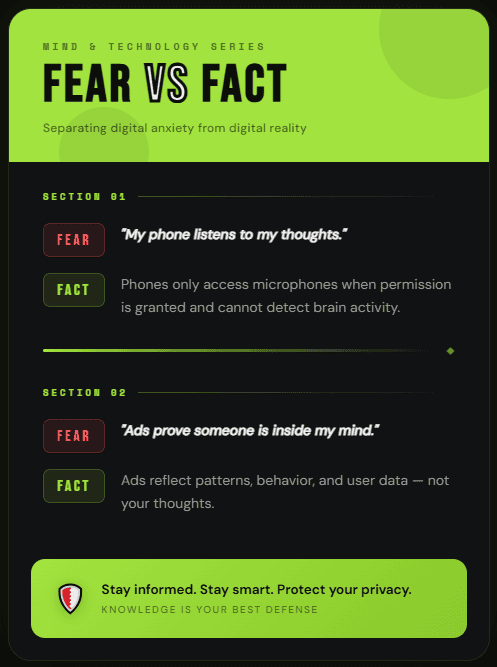
A common fear is that smartphones, Wi-Fi routers, or smart devices can access thoughts directly. There is no scientific evidence for this.
Phones do not have sensors capable of reading brain signals. Brain activity is extremely weak and requires physical contact with specialised equipment. Remote mind reading through radio waves, Bluetooth, or the internet is not scientifically possible.
Major institutions such as the
Oxford Academics and the IEEE have confirmed that non-consensual thought reading is not achievable with current technology.
Why Does it Still Feel like Technology “Knows Your Mind”
If mind reading is not real, why does it sometimes feel like technology knows exactly what you are thinking?
The answer lies in data analysis, not mind access.
Platforms track:
- Search history
- Location patterns
- App usage
- Shopping behaviour
A
McKinsey & Company survey found that over 80% of users feel companies know too much about them, but this knowledge comes from behaviour patterns, not thoughts.
When an ad appears that feels “too accurate,” it is usually responding to actions you already took, not ideas you never expressed.
Real Risks that are Often Mistaken for Mind Reading
While mind reading itself is not real, some real risks are often misunderstood as mind-reading technology.
Behavioural Prediction
Algorithms can predict what content may keep you engaged. This can shape attention, habits, and emotions.
Attention Manipulation
Endless scrolling systems are designed to hold focus for long periods. Research shows this can reduce mental clarity and increase stress.
Psychological Impact of Misinformation
Repeated exposure to fear-based content can increase anxiety and make threats feel personal and immediate.
These risks are real, measurable, and supported by research.
Separating Fact from Fear
This comparison helps separate what feels real from what is proven.
| Belief | Reality |
|---|
| Technology can read thoughts remotely | No scientific evidence |
| Phones can access brain signals | Not possible |
| Ads reflect private thoughts | Based on past behaviour |
| BCIs read minds freely | Only limited signals |
| Mental privacy is already lost | Still protected |
How to Protect your Thoughts and Mental Privacy
Since direct mind reading does not exist, protection focuses on digital and psychological safety, not physical shielding.
Digital Protection
- Review and limit app permissions
- Avoid unnecessary data-tracking apps
- Use trusted, privacy-focused tools
- Be cautious with wearable devices that collect biometric data
Mental Protection
- Reduce exposure to fear-driven tech content
- Verify claims using credible scientific sources
- Take regular breaks from screens
Stanford research shows that reduced screen exposure improves mental clarity and lowers stress.
Understanding this difference restores a sense of control.
What the Future may Look Like
Researchers are exploring ethical brain–computer interfaces to help people with paralysis or speech loss. Even optimistic projections suggest these systems will remain limited, regulated, and consent-based for decades.
NIH agree that mental privacy must remain protected by law before any future expansion of brain technology.
How Digital Overload Affects Mental Clarity and How Jolt Helps Reduce it?
A major reason people worry about mind-reading technology is not actual surveillance, but mental exhaustion caused by constant digital exposure.
Research from Harvard shows that continuous notifications, endless scrolling, and high screen time increase anxiety and reduce cognitive clarity.
When the brain is overloaded, intrusive thoughts and fear-based assumptions become more common.
Studies by Research Gate show that reducing compulsive phone use improves emotional regulation and lowers stress, which directly reduces irrational fears related to technology and privacy.
When the mind is calmer and less overstimulated, concerns about imagined threats decrease naturally.
Conclusion
Searching for how to block mind-reading technology is a natural response to rapid technological change. However, science confirms that remote, non-consensual mind reading does not exist today.
What does exist are data-driven systems that predict behaviour, not thoughts. The most effective protection is not blocking imaginary threats, but strengthening digital privacy, reducing fear-based information intake, and staying.
Frequently Asked Questions:
- Does mind-reading technology actually exist today?
No. There is no proven technology that can read human thoughts remotely or without consent. Current neuroscience tools can only detect very limited brain signals under controlled laboratory conditions using physical sensors and active participation from the individual.
- Can smartphones or Wi-Fi read my thoughts?
No. Smartphones, Wi-Fi, and smart devices do not have the capability to read brain signals. Brain activity is extremely weak and can only be measured using specialised medical equipment placed directly on or inside the body.
- Why does it feel like technology knows what I am thinking?
This feeling comes from data-based prediction, not mind reading. Apps and platforms analyse browsing history, searches, and behaviour patterns to predict interests. When predictions are accurate, they may feel personal, even though no thoughts are accessed.
- Are brain–computer interfaces a threat to mental privacy?
Current brain–computer interfaces are not a threat to mental privacy. They require consent, physical sensors, and controlled environments. Ethical guidelines and regulations strictly limit how brain data can be collected and used.
- What is the best way to protect my thoughts and mental privacy?
The best protection is reducing digital overload, verifying information from credible scientific sources, limiting unnecessary data sharing, and managing screen time. These steps reduce anxiety, improve mental clarity, and protect real digital privacy risks.

 Download Now
 Take charge of your time