What Is a Discipline Score? The New Way To Measure Your Digital Self-Control
8-minute read
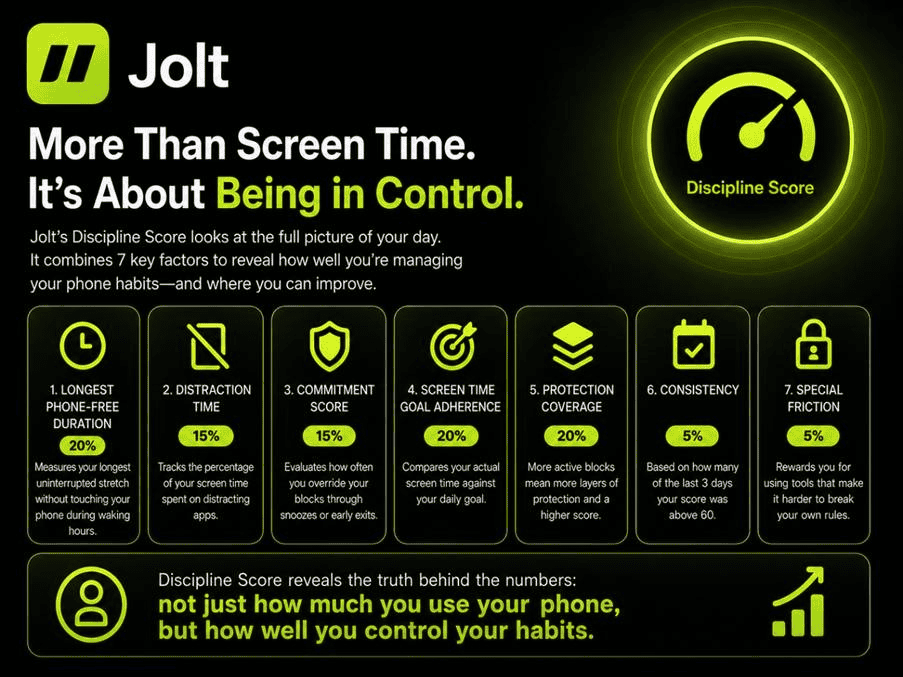
Overview: You already know you spend too much time on your phone. But knowing isn't the same as changing. Jolt's Discipline Score goes beyond tracking screen time; it measures whether you're actually in control of your habits. Six components, one honest number. Here's exactly how it works, what is Discipline Score, and why it might be the accountability tool you didn't know you needed.
Discipline Score: How Jolt Measures Whether You’re Running Your Phone — or It’s Running You
Most productivity apps track what you do on your phone. Jolt's Discipline Score tracks something harder to fake: whether you're actually in charge.
Where Focus Score zooms in on dedicated focus sessions, Discipline Score steps back and looks at your entire day. Are you staying ahead of your habits, or are you being pulled along by them? The answer lives across six components, each measuring a different dimension of self-discipline. This holistic tracking model aligns with research on behavioral automaticity published in
Scientific Reports, which demonstrates that digital habits are tightly interwoven with daily routines and environmental context, meaning that managing screen time effectively requires analyzing patterns across the entire day rather than isolating individual moments of use.
The Backbone: Three Components That Matter Most
Longest Phone-Free Duration
Longest Phone-Free Duration represents the single longest continuous period during your waking hours when you did not interact with your phone. This metric captures your ability to stay disconnected for extended stretches, which is essential for maintaining focus, reducing mental fatigue, and improving overall cognitive well-being.
This component contributes 15% to the overall metric. It specifically excludes sleep time, as sleep is evaluated separately under the Sleep Score.
For a completed day, your longest phone-free stretch is measured against your total waking hours. However, for an ongoing day, it is calculated relative only to the hours that have passed so far. This distinction is important, without it, a two-hour phone-free period in the morning would appear disproportionately small when compared to an entire day’s waking duration.
This method reflects how attention and focus actually function. Research shows that
constant smartphone use fragments attention and reduces cognitive capacity, while uninterrupted, phone-free periods help restore focus and mental clarity. By adapting dynamically throughout the day, this metric provides a more accurate and meaningful representation of your digital habits.
Screen Time Goal Adherence
Screen Time Goal Adherence measures how well you stick to the daily screen time limit you set for yourself, reflecting your ability to maintain intentional and controlled phone usage.
This component contributes 20% to your total score and works as a simple pass/fail metric. If you meet or stay below your screen time goal, you receive a full score of 100; if you exceed it, you earn zero for this component.
If no goal is set, the score is automatically zero. This design intentionally encourages you to define clear limits, reinforcing consistent and mindful digital habits over time.
Protection Coverage
Protection Coverage measures how many active blocking tools or restrictions you have running at the same time to limit distractions and control phone usage. It reflects the strength of your digital boundaries and how well you safeguard your focus.
This component accounts for 20% of your evaluation and is the most straightforward to understand: the more active blocks you have, the higher your score. It follows a stepped scale: zero blocks place you at the lowest level, while adding layers of protection steadily increases your score.
Simply put, if you're not blocking anything, there's nothing here to protect.
The Middle Layer: Distraction and Commitment
Distraction Time
Distraction Time measures the share of screen use spent on social, gaming, or distracting apps, reflecting how much your attention is pulled away. Making up 10% of the metric, it emphasizes proportion over total time. For instance, studies on
notification-driven interruptions and
smartphone notifications and attention demonstrate that even brief alerts can disrupt cognitive performance. By emphasizing proportion over raw time, this metric better captures how digital habits impact attention.
The logic is simple: someone who barely uses their phone at all and someone who's glued to it shouldn't be judged identically just because both spent 30 minutes on Instagram. What matters is how much of your actual phone time was unhelpful. Ninety minutes of distraction in a two-hour phone day is a very different story than 90 minutes in an eight-hour one.
Commitment Score
Commitment Score measures how consistently you follow your own rules and restrictions. Factoring 10% into your evaluation, snoozed minutes reduce your score. Leaving a block early halves it, in addition to snooze penalties, making it a stricter violation overall.
Per-block scores are then averaged across all your active blocks for the day. A block you left immediately without ever snoozing still takes the halving penalty; the punishment for leaving early stands on its own.
The Fine Print: Small Signals That Add Up
Consistency
Consistency measures how regularly you maintain strong digital habits over time, reflecting whether your progress is sustained or occasional. Rounding out the metric at 10% of your total score, it looks at how many of the last three days achieved a Discipline Score above 60. That fraction is converted into a 0–100 value. One good day is a start; three in a row signal a pattern.
Special Friction
Special Friction measures how intentionally you make it harder to bypass your own restrictions, reinforcing accountability and reducing impulsive behavior. Contributing 5% to your overall score, a block earns credit if it is set to Hard difficulty or has an accepted accountability partner attached, either one qualifies. The score is calculated as the proportion of your active blocks that meet this standard, rewarding stronger safeguards.
Two blocks, one Hard and one with a partner? Full 100, even though neither has both. The point is that you've made backsliding cost something.
Why Jolt’s Discipline Score Works as a Whole?
Discipline Score isn't trying to punish phone use; it's trying to detect whether your relationship with your phone is one of intention or drift. The three 20% components form the structural backbone: are you getting meaningful phone-free time, staying within your own limits, and running enough protection? Distraction Time and Commitment Score add texture around the quality and honesty of that protection. Consistency and Special Friction are the small signals that separate someone building a genuine habit from someone who had one lucky day.
This mirrors a key finding from a foundational study on digital habit loops published in
Personal and Ubiquitous Computing, which notes that modern device interactions frequently trigger automatic, cue-driven "checking habits" rather than conscious choices, making structured safeguards and environmental friction necessary to break the cycle. Together, they answer the question that matters: not how much you used your phone, but who was in control when you did.
Conclusion:
Your phone isn't going anywhere, and neither are the apps designed to keep you hooked. Discipline Score doesn't ask you to quit cold turkey. It just holds up a mirror. Show up with intention, stack your blocks, protect your time, and the number takes care of itself. One day at a time, that's how the habit actually changes.
FAQs
Why is my Discipline Score not showing today?
Discipline Score requires at least one active block to calculate; on days with no blocks running, there's nothing to measure, so the score isn't shown. Set up a block, and it will appear.
My score looks low early in the day. Is that normal?
It can be, and it's by design. Several components, particularly Longest Phone-Free Duration, recalculate continuously as the day progresses. A score that looks modest at 10 AM often climbs significantly by evening as your phone-free stretches accumulate and your screen time stays in check. The score you finish the day on is the one that counts.
Does using my phone for work hurt my Discipline Score?
Not inherently. Distraction Time only counts apps in categories like social, gaming, and entertainment, or ones you've personally flagged as distracting. Productive screen time, email, navigation, and work tools don't count against you. The score is designed to distinguish between the phone use that drains you and the kind that's just part of getting things done.

 Download Now
 Take charge of your time