Meet Jolt: Your Sleep Score, Powered by Your Habits
7-minute read
Overview: We spend a third of our lives asleep, yet hand the biggest threat to that sleep a permanent spot on our nightstand. Jolt's Sleep Score doesn't just measure your night; it measures everything your phone did to it. Six precision components, one honest number. Finally, a mirror that shows you exactly where your nights are being lost.
Your Phone Is Ruining Your Sleep — and You Have No Idea How Bad It’s Getting
You stir awake, feeling drowsy, and grab your phone before your vision clears. You browse through vaguely recalled alerts from the night before, floating through your initial hour in a blur.
It seems usual because it truly is. Not only today, but on many days.
The reality is that we have allotted a fixed position for our largest sleep disturbance next to our beds. We provide our focus and information, ensuring it's powered and prepared the instant we arise. It is not only disrupting our mornings, but it is also subtly impacting the quality of the sleep we depend on.
The majority of sleep apps solely monitor events that occur during the night. However, the actual tale begins before and carries on after you awaken. Jolt changes the inquiry from “how was your sleep?” to “how did your phone usage influence your sleep?”
What Is a Sleep Score — and Why Should You Care?
A Sleep Score is a single number that reflects how well you slept overall, not just how long you slept, but also the quality, consistency, and other factors that influence your sleep. Think of it like a credit score for your recovery, shaped by how you wind down on your phone before bed, how you sleep through the night, how you start your morning, and how consistently you show up over time.
It matters because sleep is not just an isolated event; it is a system. Eight hours in bed means little if it is disrupted by late-night scrolling, middle-of-the-night phone checks, or reaching for your screen the moment you wake. Each habit chips away at your recovery. The Sleep Score brings all of this together into one clear number you can track, understand, and improve.
The Six Science-Backed Forces Behind Your Night
Sleep Hygiene
Sleep hygiene refers to the quality of your habits and behaviors during the hours intended for sleep. It reflects how well you maintain an environment and routine that supports uninterrupted, restorative rest. Research curated by the
Sleep Foundation highlights how overnight screen time and artificial blue light can directly suppress melatonin production and fracture your sleep architecture.
This section carries the most weight (30%) because it shows what actually happened during your sleep window. It combines two key factors: total phone usage during your sleep hours and overnight pickups. Phone usage is measured against your sleep goal, while each pickup lowers your score, with zero being ideal.
These factors are weighted together, with time spent on the phone having a greater impact than how often you check it, since longer disruptions are more harmful to sleep quality than brief interruptions.
For example, strong overall usage but frequent pickups might result in a score around 79, indicating a good night, though not a perfect one.
Wind-Down Behavior
Wind-down behavior refers to how you use the time leading up to sleep, specifically, whether your actions help your mind and body relax or keep them stimulated. This period plays a crucial role in preparing you for restful sleep. According to the
Sleep Foundation, giving yourself a dedicated screen-free window allows your body's internal clock to transition smoothly into sleep without being delayed by the artificial light and cognitive stimulation of electronic devices.
This section accounts for 20% of your overall score and focuses on the two hours before bedtime, whether you intentionally treat them as a wind-down period or not. Jolt evaluates this window using two key signals.
First, it looks at your phone usage during this time, including both total screen time and pickups. Frequent short check-ins score worse than a single longer session, as fragmented attention disrupts the natural process of winding down more significantly.
Second, there is a strict cutoff: whether your last phone pickup ended before your set bedtime. If it did, you receive a full score. If it extends even one minute past bedtime, the score drops to zero, there is no partial credit.
One important detail: if a pickup begins before bedtime but continues past it, the end time is what matters. If your screen is still on, you are still considered to be using your phone.
Wind-Down App Quality
Wind-down app quality reflects whether the apps you use before bed help you relax or keep you mentally stimulated.
This component accounts for 10% of your overall score and evaluates what you do on your phone during the wind-down window. Apps considered distracting, such as Social, Games, or Entertainment, lower your score. A study published in the
Journal of Adolescent Health demonstrated that interactive or cognitively demanding screen use, like messaging friends or playing games, causes significantly greater delays and reductions in sleep than passive media because it drastically increases cognitive arousal right before bed. For example, if 40% of your usage is on distracting apps, your score becomes 60.
If your usage is limited to neutral or calming activities, like notes, calls, or simple utilities, your score remains high regardless of total time. This component measures what you use, not how long, that’s covered by Wind-Down Behavior.
If you don’t use your phone at all in this window, you receive a perfect 100.
Morning Start
Morning Start reflects how you use your phone in the first two hours after waking, and whether that behavior supports a calm, intentional start to your day.
This component makes up 20% of your overall score and mirrors Wind-Down Behavior. Jolt tracks both total phone time and pickups during this window, more engagement leads to a lower score. Research published in
The Open University indicates that interacting with digital notifications immediately upon waking triggers instant cognitive distraction and heightens baseline stress levels, fracturing your focus before the day even begins.
There’s also a binary check on your first pickup: did it happen before or after a target point in your morning routine? Before earns a full score, after drops it to zero. If you haven’t picked up your phone yet when the score runs, you receive a perfect 100 by default.
Morning phone behavior is just as important as evening behavior, which is why both windows
Wake-Up App Quality
Wake-up app quality reflects whether the apps you use in the morning support a calm start or create early mental stimulation.
This component makes up 10% of your overall score and evaluates how much of your phone time in the first two hours is spent on distracting apps. Activities like social media or games lower your score. An analysis discussed by
Psychology Today explains that diving straight into highly stimulating or emotionally charged digital content right after waking up drains mental energy, leaves you reactive, and casts a negative halo effect over your productivity for the rest of the day. Conversely, calmer uses, like checking the weather or reading, keep your score high.
It captures the difference between starting your day intentionally versus jumping straight into distraction.
Consistency
Consistency reflects how regularly you maintain good sleep behavior over time, rather than relying on occasional good nights. This component accounts for 10% of your overall score and looks at your past three nights, counting how many scored above 60. Three good nights earn 100, two score around 67, one about 33, and zero remains zero.
It exists because one great night surrounded by poor ones isn’t a habit, it’s luck. Consistency rewards showing up repeatedly, which is where real sleep health is built.
How Jolt Puts It All Together
The six components combine as follows: Sleep hygiene affects the sleep score the most. Wind-down behavior and morning start are the next most influential factors. App quality for each has a smaller influence, and consistency has the least effect. Additionally, habitual timing, environment, and stress management subtly shift scores by influencing sleep quality and recovery.
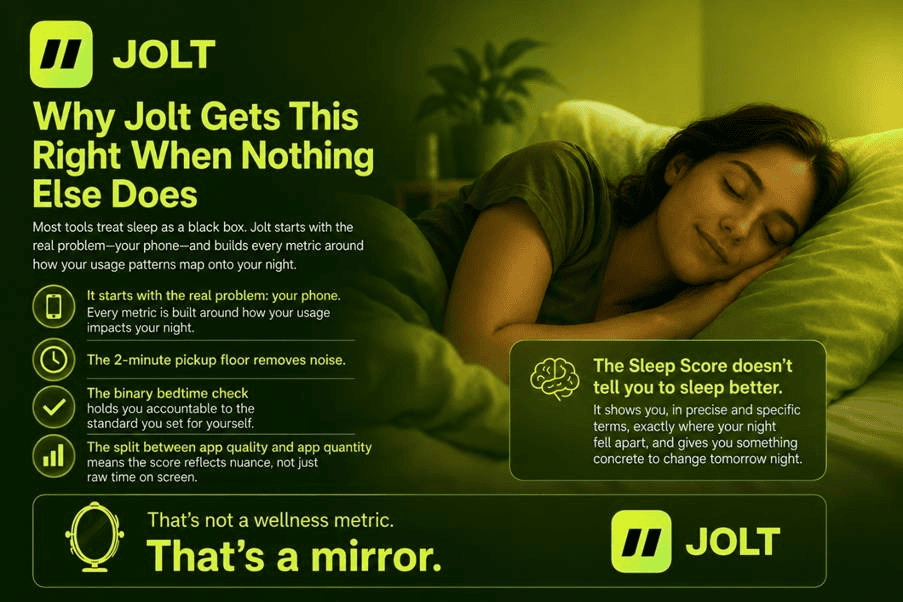
Why Jolt Gets This Right When Nothing Else Does
Most tools treat sleep as a black box. They sense your movement and breathing, assign you a score, and leave you with nothing actionable. Jolt works from the opposite direction.
It starts with the thing that's actually disrupting your sleep, your phone, and builds every metric around how your usage patterns map onto your night. The binary bedtime check holds you accountable to the standard you set for yourself. The split between app quality and app quantity means the score reflects nuance, not just raw time on screen.
The Sleep Score doesn't tell you to sleep better. It shows you, in precise and specific terms, exactly where your night fell apart, and gives you something concrete to change tomorrow night.
That's not a wellness metric. That's a mirror.
Conclusion
Sleep isn't something that happens to you; it's something you either protect or surrender. Every late-night scroll, every 2 AM pickup, every morning reach for the phone adds up quietly until the damage becomes your baseline. Jolt makes the invisible visible. The Sleep Score won't fix your nights alone, but an honest number you can no longer ignore is exactly where real change begins.

 Download Now
 Take charge of your time