What Is 'Technoference' and Is It Quietly Wrecking Your Relationship?
10-minute read
Quick answer: Technoference is the everyday interruption of face-to-face relationships by phones and other devices, a glance at a notification, a phone propped up during dinner. Coined by researchers McDaniel and Coyne in 2016, it's linked to more conflict, lower relationship satisfaction, lower life satisfaction, and higher depression, even when the interruptions are brief and unintentional.
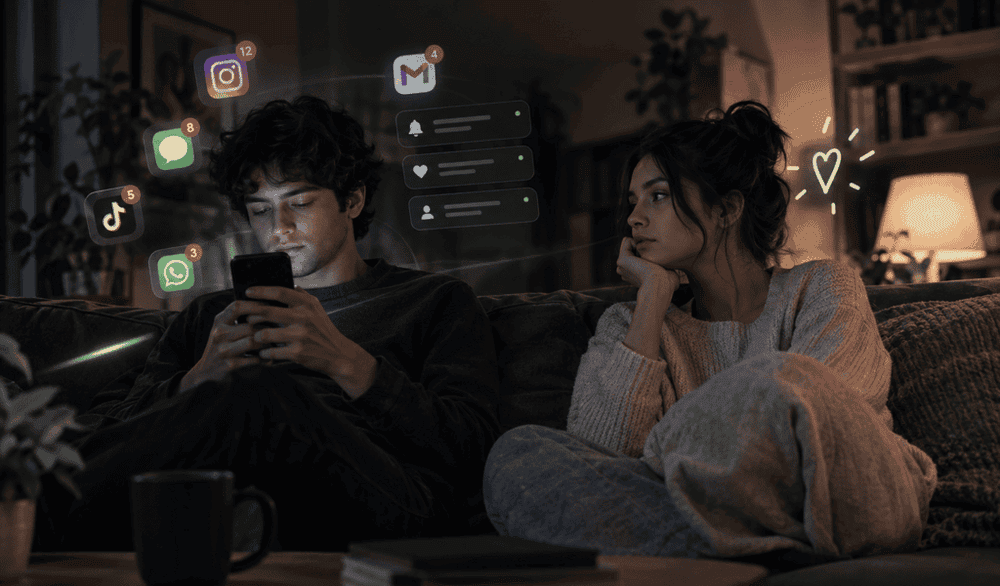
You're mid-sentence, telling your partner about your day, and their eyes drift, just for a second, to the phone lighting up on the table. It's such a small moment that neither of you registers it as a big deal. But psychologists have a name for it, and they've spent the last decade studying what it does to relationships:
technoference.
Proposed by researchers Brandon McDaniel and Sarah Coyne, the term describes the everyday intrusions technology makes into face-to-face connection: the glance at a notification during dinner, the phone propped up during a movie night, the scroll before a conversation has really finished. None of it feels like betrayal. That's exactly why it's so easy to miss, and so effective at wearing a relationship down over time. As notifications, group chats, and endless feeds compete harder than ever for attention, understanding what technoference actually does and what the research says matters more than ever for anyone trying to keep a relationship feeling close.
How Does Technoference Impact Relationships and Behavior?
Technoference rarely announces itself as a problem. It shows up as micro-interruptions, a paused conversation, a half-finished thought, a partner who answers "mhm" while looking at a screen. In one of the founding studies on the topic, surveying married and cohabiting women, researchers found that frequent technology interference in their relationships was reported alongside more conflict over device use, lower relationship satisfaction, lower life satisfaction, and more symptoms of depression. Notably, most of the women in that sample said this kind of interruption happened at least occasionally in their day-to-day lives, which suggests it's less an occasional slip than a routine feature of modern relationships.
Researchers describe the resulting pattern as circular: small interruptions cause friction, friction lowers satisfaction, and lower satisfaction pushes people toward their phones for comfort, which invites even more interference. Left unchecked, this loop can shape how safe and attended-to both partners feel in the relationship, often without either person clocking exactly when or how it started.
The effect isn't limited to romantic partners, either. A
related study on coparenting found that when technology repeatedly interrupted parents' interactions with each other around childcare, both mothers and fathers reported worse coparenting quality, which is closely tied to how satisfied couples feel in the relationship overall. Technoference doesn't just steal a moment from a conversation; it chips away at the trust and attentiveness a relationship runs on, one small distraction at a time.
Is Technoference Wrecking Your Love Life?
If you've ever felt a flicker of hurt when your partner checked their phone mid-conversation, you've experienced what researchers call "phubbing," short for phone snubbing. Studies on
partner phubbing describe it as a kind of micro-ostracism: even brief, seemingly harmless glances at a screen can leave the other person feeling a diminished sense of belonging and lower self-esteem, even though nothing was technically said or done wrong. In one survey of U.S. adults cited in that research, nearly half said they'd experienced this from a partner, and roughly a quarter called it an outright problem in their relationship.
A
2026 study from the University of Connecticut and Columbia University found that people who felt phubbed by their partner reported feeling less loved and cared for, along with lower relationship satisfaction and greater emotional distance, an effect that was especially pronounced during high-stress periods. Notably, the damage occurred even when both partners had similar phone habits, suggesting it isn't about hypocrisy so much as attention itself. Being deprioritized for a screen, even for thirty seconds, can send a message that outweighs the actual amount of time lost. So no, it isn't dramatic to say a habit this small can genuinely wear down a love life; the research backs up the feeling.
Technoference: 5 Surprising Ways It Impacts You
Technoference's effects go beyond hurt feelings in the moment. Research has traced its influence into places most couples wouldn't expect:
- It changes how your brain works, even when your phone is off. A widely cited study on cognitive capacity found that merely having a smartphone within reach — face-down, silenced, screen off- measurably reduced people's available mental bandwidth, because part of the brain is constantly working to resist checking it. The effect was strongest for those who considered themselves most dependent on their phones, and it held even when the device sat in a bag rather than in plain sight.
- It spills into parenting. Parents who are frequently interrupted by devices during time with their children have been linked, in longitudinal research, to greater child behavior problems, including more acting-out and withdrawal, with parenting stress often acting as the link between the two.
- It fuels a self-reinforcing cycle. Conflict over phone use lowers relationship satisfaction, which lowers life satisfaction, which can raise the odds of reaching for a device to self-soothe, starting the loop over again.
- It dents self-esteem, not just mood. Being on the receiving end of phubbing has been experimentally linked to a measurable drop in feelings of belonging and self-worth, not only relationship happiness.
- It's linked to broader mental health patterns. A large 2024 systematic review covering more than a million participants found small but consistent associations between heavy or problematic device use and higher rates of anxiety and depression.
How Technoference Happens: 10 Ways to Reduce It
Technoference usually creeps in through habit, not intention; the phone becomes a reflex during any lull, wait, or silence. The good news is that because it's built from small, repeated choices, it can be undone the same way.
- Create phone-free windows. Set aside mealtimes or the first 30 minutes home from work as non-negotiable device-free time together.
- Charge phones outside the bedroom. Keeping devices out of arm's reach at night protects both sleep and the last real conversation of the day.
- Turn off non-essential notifications. Fewer buzzes mean fewer moments where attention silently slips away from the person in front of you.
- Name it when it happens. Gently flagging "I felt a bit tuned out just now" works better than resentment that quietly builds.
- Batch your scrolling. Check social media and email in set windows rather than reflexively, so it doesn't bleed into shared time.
- Go beyond face-down. Even a visible, silenced phone reduces feelings of closeness; putting it in another room helps more than just flipping it over.
- Rebuild small rituals. A short walk, coffee, or evening debrief without screens rebuilds the habit of undivided attention.
- Watch for the "just checking" trap. One glance rarely stays one glance, so build in a pause before picking the phone up at all.
- Model it for kids. Children register parental technoference too, so consistent phone-free time together sets the tone for the whole family.
- Set shared norms, not one-sided rules. Boundaries work best when both people agree to them together, rather than one partner enforcing them on the other.
How to Prevent 'Technoference' From Ruining Your Relationship?
Preventing technoference isn't about rejecting technology altogether; it's about deciding, together, when it gets to interrupt you. One of the most consistently recommended strategies from relationship researchers is establishing
technology-free zones: specific places, like the bedroom or the dinner table, or specific times, like after a set hour or during date nights, where phones are simply set aside for both partners, no exceptions.
What makes this work isn't willpower so much as removing the constant, low-grade decision of whether to check a device in the first place. Couples who negotiate these boundaries together, rather than one partner policing the other, tend to stick with them longer, because the rule feels like a shared value rather than a punishment.
It also helps to separate connection time from convenience time. Not every interruption is technoference; sometimes a text truly can't wait. The difference is whether checking a phone becomes the default response to any pause in conversation, or a deliberate, occasional exception. Relationships that protect a few consistent windows of full attention each day tend to weather everyday interruptions far better than ones trying to eliminate screens entirely, which is rarely realistic and rarely necessary.
Start smaller than feels necessary. A single protected hour each evening, held consistently, does more for a relationship than an ambitious digital detox that quietly falls apart after a week. Prevention, in the end, is less about the technology and more about repeatedly choosing each other over it.
How Jolt Intervenes
The prevention strategies above share a common thread: they work better as a shared, structural decision than as something one partner tries to enforce on willpower alone. That's the specific gap Jolt is built to close, not by replacing the conversation with your partner, but by making the boundary you already agreed on easier to actually hold.
- Turn phone-free windows into something automatic. A recurring Session covering dinner or the first 30 minutes home from work locks distracting apps for that window every day, so it stops being a willpower decision made fresh each evening.
- Keep emergency contacts reachable without reopening everything else. Always Allowed Apps keeps calls, messages, or specific essential apps reachable during a session, so a phone-free window doesn't mean being unreachable for something that actually can't wait.
- Protect the boundary at night, specifically. Sleep Schedule locks chosen apps during a wind-down window before bed, which directly supports the “charge phones outside the bedroom” advice above without requiring either partner to remember to do it manually.
- Make it a shared decision, not a one-sided rule. Accountability Partner lets a partner (or anyone else you choose) be part of approving changes to a session, which mirrors the article's own finding that boundaries negotiated together hold up better than ones policed by only one person.
None of this replaces naming the moment out loud or agreeing on the boundary in the first place; that part still has to happen between the two people involved. What it changes is what happens after the agreement: instead of relying on both people remembering and resisting in the moment, every day, the structure holds itself.
FAQ
How does technology impact relationships?
Technology itself isn't harmful; how it's used is what matters. Frequent interruptions during shared time, known as technoference, are linked to more conflict, lower relationship satisfaction, and reduced closeness between partners. Even a phone's mere presence can lower attentiveness. Used intentionally, though, technology also helps couples stay connected across distance and coordinate daily life more easily than before.
How has technology affected the types of relationships?
Technology has widened how relationships form and last; long-distance partnerships, online-first friendships, and coparenting across separate households are now far more common. At the same time, it has introduced new categories of connection, like parasocial attachments to online figures, and new sources of friction, like technoference, that earlier generations of couples never had to manage.
How does technology affect family relationships?
Within families, research links frequent parental device use during shared time to lower parent-child warmth and more child behavior problems, since children register when a caregiver is distracted, even briefly. Technoference has also been tied to poorer coparenting quality between partners. Families that set shared, consistent screen-free times together tend to report stronger connection and fewer of these effects.
What are 10 negative effects of technology?
Commonly documented effects include: lower relationship and life satisfaction, more conflict over device use, reduced attentiveness and cognitive capacity, poorer sleep, increased anxiety and depressive symptoms, lower self-esteem, weaker parent-child interactions, more child behavior problems, feelings of exclusion through phubbing, and a self-reinforcing cycle where distress drives more device use, deepening disconnection further.
How does technology affect mental health?
Large-scale reviews link heavy or problematic technology and social media use to modestly but consistently higher rates of anxiety, depression, and lower overall well-being, particularly among younger users. The picture is nuanced; technology can also provide real support and connection, but patterns like compulsive checking and technoference in close relationships are consistently tied to worse mental health outcomes over time.

 Download Now
 Take charge of your time