What Is Brown Noise and Does It Actually Help You Fall Asleep Faster?
Brown noise may help some people fall asleep faster by covering traffic, voices, doors, and other changing sounds. However, there is not enough direct research to prove that brown noise improves sleep for everyone.
Research on sound and
sleep mainly studies white noise, pink noise, or general broadband sound. Brown noise is popular online, but its specific effect on sleep has not been tested as deeply. It should be treated as a personal sleep aid, not a medical treatment.
Sleep problems are common. According to a 2026 report from the
CDC, 30.5% of adults slept for less than seven hours in 2024. The same report found that 15.4% had trouble falling asleep most days or every day.
What Is Brown Noise?
Brown noise is a continuous sound with more power in its lower frequencies. It sounds deeper and heavier than white or pink noise.
People often compare it to:
- A powerful waterfall
- Heavy rain
- Low ocean waves
- Distant thunder
- The hum inside an aircraft
- A strong fan or air-conditioning system
Brown noise is also called Brownian noise or red noise. Its name comes from Brownian motion, not from the colour brown.
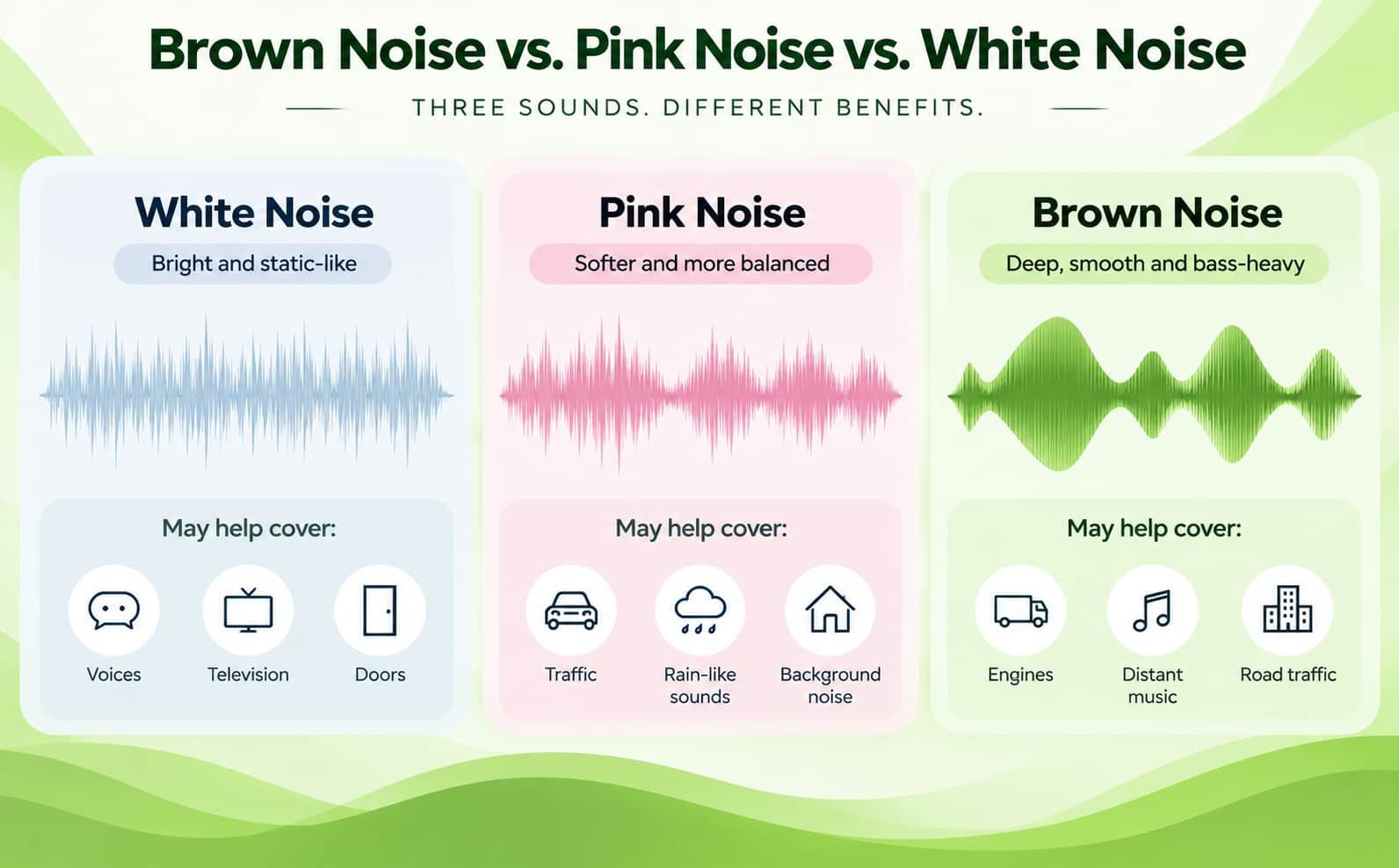
White noise contains sound across the full frequency range and often sounds like television static.
Pink noise has stronger lower frequencies and may sound like soft rain. Brown noise places even more energy in the low-frequency range, producing a deeper sound similar to a waterfall.
Brown Noise vs White Noise vs Pink Noise
| Type of sound | What it sounds like | What it may help cover |
|---|
| White noise | Bright and static-like | Voices, television, doors and household sounds |
| Pink noise | Softer and more balanced | Light traffic, rain-like sounds and general background noise |
| Brown noise | Deep, smooth and bass-heavy | Engines, distant music, road traffic and low building sounds |
None of these sounds is automatically better for every person. The right option depends on your bedroom, the sounds disturbing you and your personal comfort.
Does Brown Noise for Sleep Actually Work?
The evidence is promising for some forms of steady sound, but it is not conclusive for brown noise itself.
A systematic review examined 34 studies involving 1,103 participants. Nineteen studies reported improvements in at least one sleep outcome. Positive results were found in 6 of 18 white-noise studies, 9 of 11 pink-noise studies and 4 of 6 studies using mixed audio. However, the studies differed in quality, sound level, duration and participant type.
This review did not provide strong proof for brown noise for sleep. It mainly shows that carefully selected sound may help certain people under certain conditions.
A controlled study involving young, healthy adults with temporary sleep difficulty found that broadband sound reduced the time needed to fall asleep by 38% compared with normal environmental noise. The sound used was filtered white noise, not brown noise. Therefore, the finding cannot be applied directly to every brown-noise track.
The honest conclusion is simple: brown noise may work through the same general sound-masking process, but researchers still need to study it directly.
How Could Brown Noise Help You Sleep?
Brown noise for sleep may be useful because it creates a steady sound environment. It does not remove outside noise. Instead, it makes sudden sounds less noticeable.
Imagine trying to sleep in complete silence. A car horn, closing door, barking dog or moving chair can easily catch your attention. A continuous background sound reduces the difference between silence and that sudden noise.
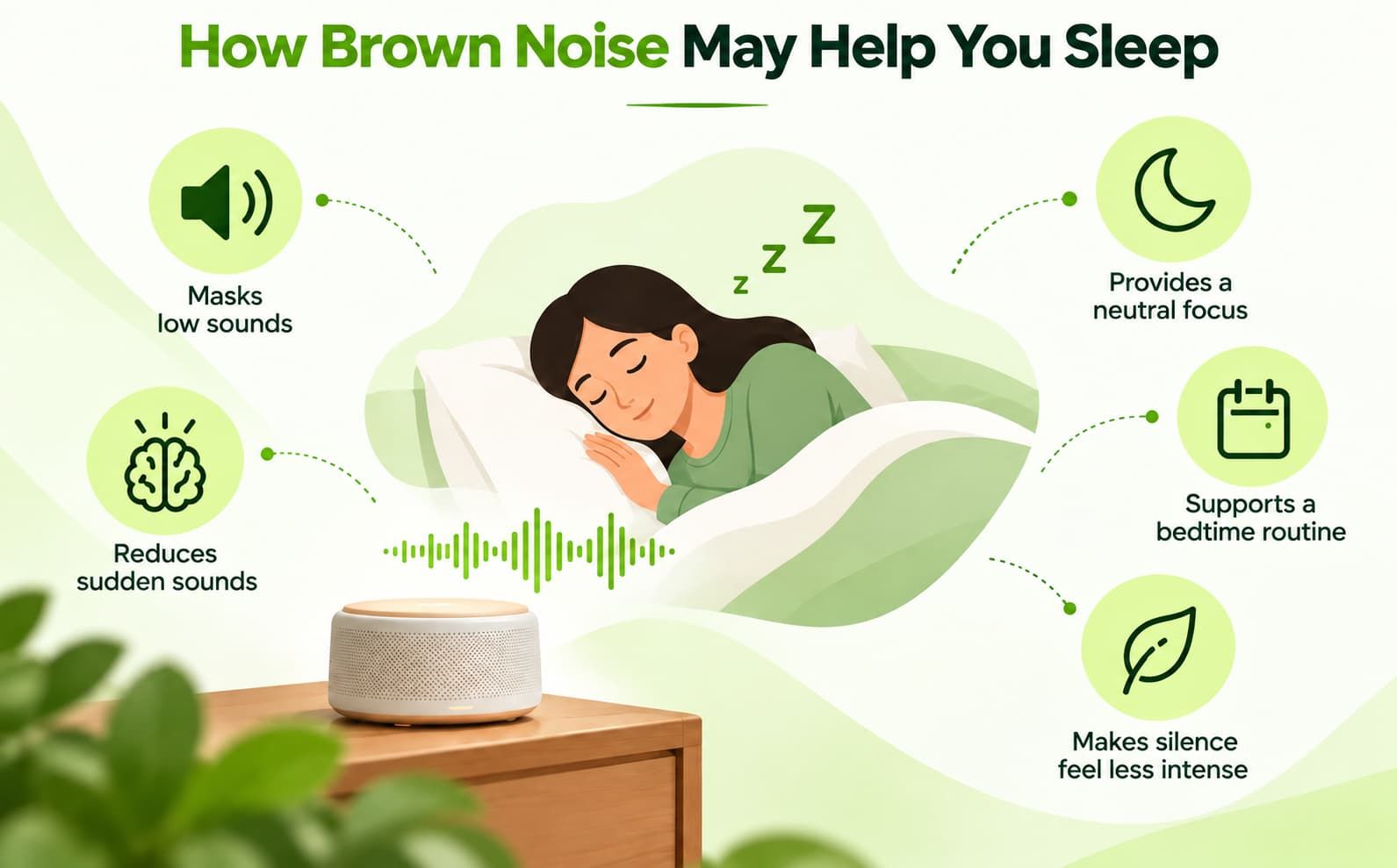
Brown noise may help by:
- Masking low sounds: Its deep tone may cover traffic, engines, lifts, distant music and sounds from nearby rooms.
- Reducing sound changes: The brain may react less strongly when the room’s sound remains steady.
- Giving the mind a neutral focus: Some people find one simple sound easier to ignore than changing thoughts or irregular noises.
- Supporting a bedtime routine: Repeating the same sound every night may signal that it is time to settle down.
- Making silence feel less intense: People who become more alert in complete silence may feel calmer with soft background sound.
Environmental noise is a genuine sleep concern. The
World Health Organization says noise can contribute to sleep disturbance and recommends keeping bedroom noise below 30 A-weighted decibels at night for good-quality sleep.
Could Brown Noise Make Sleep Worse?
Yes, it is possible.
Sound that is too loud, uncomfortable or played throughout the night may disturb sleep rather than improve it. An
Oxford Academic study found that continuous pink-noise exposure reduced REM sleep in a dose-dependent way. The study tested pink noise, not brown noise, but it shows why people should not assume that every continuous sound is harmless.
Another recent
scientific review concluded that evidence for coloured-noise sleep aids remains mixed. Some users may benefit, especially in noisy settings, while others may sleep better in silence.
Brown noise may not suit you when:
- The bass creates pressure or discomfort.
- You become focused on the sound.
- The track changes volume unexpectedly.
- Advertisements interrupt the recording.
- You play it loudly through earbuds.
- Your bedroom is already quiet.
Who May Benefit From Brown Noise?
Brown noise for sleep may be worth testing when you:
- Live near a busy road or railway.
- Hear neighbours through the walls.
- Sleep beside someone with a different schedule.
- Wake easily because of doors, footsteps or vehicles.
- Find white noise too sharp.
- Already feel relaxed by rain, waterfalls or deep fan sounds.
It may not solve sleep problems caused by anxiety, pain, caffeine, irregular sleep times, sleep apnoea, restless legs or another health condition.
How to Use Brown Noise Safely
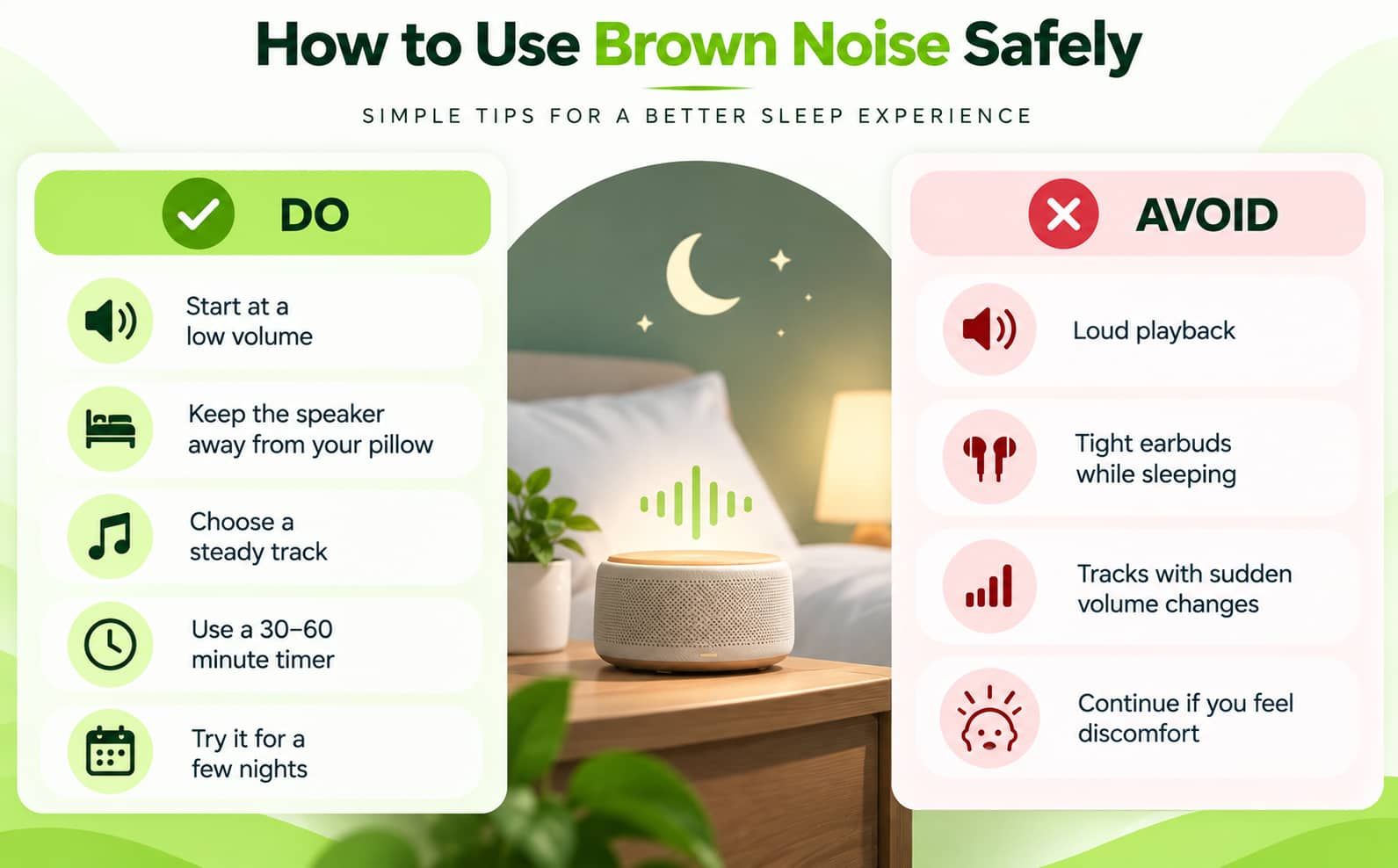
Begin with a low, comfortable volume. The aim is to soften outside sounds, not overpower them.
For better results:
- Place the speaker away from your pillow.
- Select a steady track without music, voices or advertisements.
- Use a timer for 30 to 60 minutes at first.
- Avoid sleeping with tight earbuds.
- Test it for five to seven nights.
- Record when you went to bed and how rested you felt.
- Stop when it causes discomfort, headaches or ringing in your ears.
Be especially careful when using sound machines around babies or young children. A 2024 scientific review raised concerns about incorrect or prolonged use and called for greater attention to sound levels and exposure.
Combine Brown Noise With a Screen-Free Routine
Brown noise will not help much when you continue scrolling in bed. The
CDC recommends keeping the bedroom quiet, relaxing and cool, following regular sleep times and turning off electronic devices at least 30 minutes before bedtime. Adults aged 18 to 60 should generally get seven or more hours of sleep.
A practical routine can include:
- Set the same bedtime each night.
- Start a wind-down period 30 to 60 minutes earlier.
- Block social media and entertainment apps.
- Keep alarms, messages and emergency apps available.
- Play brown noise at a gentle level.
- Avoid checking your phone after getting into bed.
- Review your sleep pattern at the end of the week.
Use Jolt as it can automatically block selected apps between bedtime and waking. It can also include a wind-down reminder, morning grace period, always-allowed apps and sleep-related insights.
How Jolt Helps You Build a More Consistent, Screen-Free Bedtime Routine
Brown noise may make your bedroom feel calmer, but it cannot stop late-night scrolling. Jolt helps manage the digital side of sleep by creating clear boundaries around bedtime and morning phone use.
With Jolt’s Sleep Schedule, users can:
- Set a regular bedtime and wake-up time.
- Block selected social media, gaming, or entertainment apps overnight.
- Create a wind-down period before bed with either a gentle reminder or a firm block.
- Add a morning grace period to avoid checking distracting apps immediately after waking.
- Keep essential apps available, including alarms, meditation apps, messages, and emergency contacts.
- Review sleep scores and routine insights to understand how consistent their habits are.
Brown noise and
Jolt app solve two different bedtime problems. Brown noise can reduce the impact of environmental sounds, while Jolt
reduces digital interruptions that may keep the mind active. Together, they can support a quieter, more structured evening routine.
Conclusion
Brown noise for sleep may help when unpredictable environmental sounds are keeping you awake. Its deep tone can mask traffic, voices and household noise, but direct research is still limited. Use it quietly, test it for several nights and combine it with a regular bedtime. With Jolt’s
Sleep Schedule, wind-down controls, morning grace period and app
blocking, you can remove late-night digital distractions and create a calmer sleep routine.
Frequently Asked Questions:
- Can brown noise help you fall asleep faster?
Yes, brown noise may help by masking traffic, voices, and sudden sounds. Its deep, steady tone can make the bedroom feel calmer, although results differ from person to person.
- Is brown noise scientifically proven to improve sleep?
No, direct research on brown noise for sleep is still limited. Most studies focus on white noise, pink noise, or broadband sound, so stronger evidence is still needed.
- Can brown noise be played throughout the night?
Yes, but it should stay at a low, comfortable volume. A timer may be better for beginners, especially when the room becomes quiet after they fall asleep.
- Is brown noise better than white noise for sleeping?
No, brown noise is not automatically better. It sounds deeper and softer, while white noise is sharper. The best option depends on personal comfort and surrounding noise.
- Can Jolt help improve a bedtime routine?
Yes, Jolt can block distracting apps, create a wind-down period, protect morning time, keep essential apps available, and provide sleep insights for a more consistent routine.

 Download Now
 Take charge of your time