Active vs. Passive Screen Time: What Actually Matters for Your Mind
Two people can both spend three hours on their phones and feel completely different afterward. One chatted with friends, wrote, and planned a trip. The other scrolled. Research increasingly suggests the type of screen time matters as much as the amount, and this article explains the difference, what the evidence shows, and how to shift your own habits.
Quick answer: Active screen time means interacting, creating, or communicating. Passive screen time means consuming content without engaging, like scrolling a feed or binge-watching. Studies link passive use to lower mood, mainly through social comparison, while active use is neutral or mildly positive. Most effects are small, so the habit that matters is how you feel when you put the phone down.
Key Takeaways
- The type of use matters. Active use means interacting or creating. Passive use means scrolling and watching.
- Passive use has the stronger link to low mood. Experiments point to envy and social comparison as the likely path.
- Active use is not automatically healthy. Benefits show up mainly with messages tailored to close friends.
- Effects are modest. A review of 141 studies found most associations were small.
- Limits can help. Students who capped social media at about 30 minutes a day reported less loneliness and depression.
- Shift, do not just cut. Replacing a passive habit with an active one is easier than white-knuckling a ban.
What Is the Difference Between Active and Passive Screen Time?
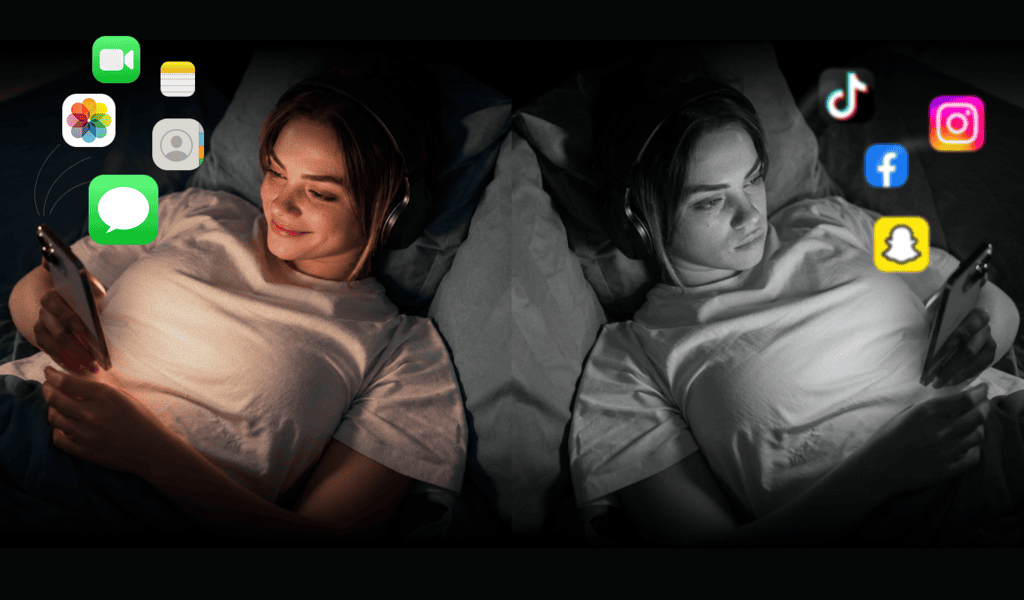
Active screen time is any use where you respond, make, or decide: messaging a friend, writing, editing photos, learning a skill, or playing a game that demands skill. Passive screen time is consuming without doing much back: scrolling a feed, letting autoplay run, or watching video with no particular intent. The line is about your role, not the device. The same app can sit on either side depending on whether you are talking to someone or just watching a stream of strangers.
How Do Active and Passive Screen Time Compare?
| Feature | Active screen time | Passive screen time |
| Your role | Creating, replying, deciding | Receiving, scrolling, watching |
| Typical examples | Messaging, writing, learning, building | Feed scrolling, autoplay, background video |
| Natural stopping point | Task or conversation ends | None, the feed refills itself |
| Research link to mood | Neutral to mildly positive | Linked to lower mood in several studies |
| Main risk | Crowding out sleep or focus | Social comparison and lost time |
Does Passive Screen Time Really Harm Your Mood?
Often it does, and the best evidence comes from experiments, not only surveys. In a
laboratory and field study of Facebook users, passive use caused measurable declines in emotional well-being, and envy explained much of the effect. Watching other people's highlights invites comparison, and comparison rarely flatters.
The pattern extends beyond social media. A
meta-analysis of 12 prospective studies covering more than 128,000 people found that mentally passive sedentary behavior, such as watching television, was linked to a higher risk of depression (relative risk 1.17). Mentally active sedentary behavior, such as computer use, showed no meaningful link (0.98). These are observational findings, so they show a pattern, not proof of cause.
Is Active Screen Time Always Good for You?
No, and the nuance is worth knowing. A
large survey of 1,910 Facebook users found that only targeted, composed messages from close friends were tied to improved well-being. One-click reactions like likes had no effect, and the study did not find passive viewing linked to declines. Active only helps when it is real communication with people you care about.
Scale matters too. A
meta-analysis of 141 studies with roughly 145,000 participants found that most associations between active or passive use and mental health were negligible. The strongest was active use and online social support. The fair summary: how you use a screen shapes how you feel, but it is one influence among many, not a verdict.
Why Is Passive Scrolling So Hard to Stop?
Passive formats have no built-in ending. A conversation finishes, a task gets done, a show has a final episode. A feed simply refills, so the decision to stop has to come from you every few seconds. That is a design property, not a character flaw. It also explains why passive sessions run long without feeling like a choice: nothing ever marks the moment to quit, so attention drifts instead of ending.
For many people, the trigger is boredom or a small emotional itch. The phone relieves it instantly, which teaches the habit to repeat. Naming that loop, "I am reaching for this because I am bored," is a useful first step because it separates the urge from the action.
Can Limiting Screen Time Improve How You Feel?
Modestly, yes. In a
randomized study of 143 university students, participants limited Facebook, Instagram, and Snapchat to 10 minutes per platform per day for three weeks. Compared with a control group, they reported significant reductions in loneliness and depression. Both groups improved on anxiety and fear of missing out, which suggests that simply paying attention to your own use can help.
Treat that as an experiment you can run, not a universal prescription. The sample was students and the period was short, so results may not carry over to every age or lifestyle.
How Can You Shift Passive Time into Active Time?
Replacing beats removing. Try these four swaps:
- Message instead of scroll. When you open a feed out of boredom, send one real message to a friend instead.
- Add a stopping point. Set a timer or use an app limit so the session has an end the feed never provides.
- Choose before you watch. Pick the show or video first, then watch it. Choosing is already more active than browsing.
- Check the aftertaste. Ask how you feel in the first minute after you stop. Keep what leaves you better and trim what does not.
Small, specific swaps hold up better than vague promises to use your phone less.
How Jolt Fits into This
Two of the four swaps above are easier to sustain with real structure behind them rather than relying on remembering to do them every time.
- “Add a stopping point” is exactly what a Duration Limit or Open Limit does: once you hit the cap on a passive app, it locks for the rest of the day, so the feed's lack of a natural ending stops being your problem to manage in the moment.
- “Message instead of scroll” can be built in structurally with Good Apps First: require a few minutes in a messaging or notes app before a passive feed unlocks, so the active swap happens before the passive default, not as a willpower contest against it.
Neither replaces the four swaps themselves; they're still the actual behavior change. What structure adds is removing the moment-by-moment decision to follow through on them.
Frequently Asked Questions
What is passive screen time?
Passive screen time is consuming content without interacting or creating, such as scrolling feeds, binge watching, or letting autoplay run. Attention is mostly received, with little replying, thinking, or making.
Is all passive screen time bad?
No. The evidence is mixed, and effects are often small. A film you chose differs from endless scrolling. Intent, a clear stopping point, and how you feel afterward matter more than the label.
Is active screen time always healthy?
No. Messaging close friends is linked to benefits, but late-night chats, work email, or gaming can still crowd out sleep. Active use helps most when it is purposeful and finite.
How much passive screen time is too much?
There is no official threshold. One study capped three social apps at around 30 minutes daily and saw better mood within three weeks. Treat that as a test to try, not a rule.
How can I turn passive scrolling into active use?
Replace the default, not just the minutes. Message a person instead of browsing a feed, make or write something, or set a limit that closes the app so sessions end.

 Download Now
 Take charge of your time



 Twinkle