Ragebait, Doomscrolling, and the Attention Trap: Why Outrage Keeps You Glued to Your Screen
8-minute read
Have you ever opened social media for a quick check and found yourself thirty minutes later reading heated arguments between strangers?
You are not alone.
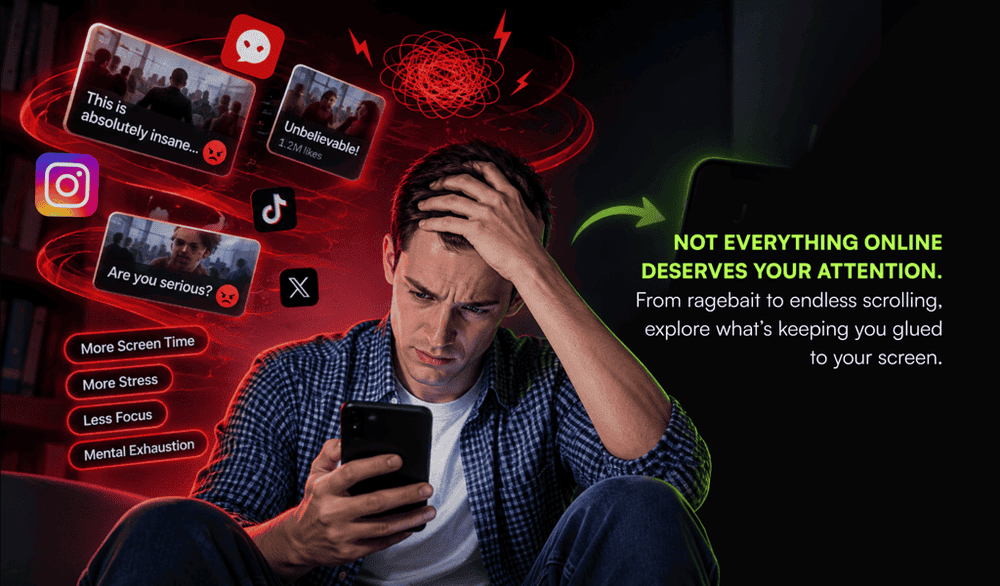
What starts as a quick glance at your feed often turns into a long session of scrolling through controversial opinions, frustrating news stories, and comments designed to provoke a reaction. This phenomenon is closely tied to two growing digital habits: ragebait and doomscrolling.
As platforms compete for attention, outrage has become one of the most effective ways to keep users engaged. The result is an attention trap that can quietly increase screen time, reduce focus, and leave people feeling mentally exhausted.
Understanding how ragebait works is the first step toward breaking free from it.
TL; DR
- Ragebait is content built to make you angry so you comment, share, and keep scrolling.
- Your brain’s negativity bias makes outrage hard to ignore, and algorithms reward the engagement it creates.
- The cost is real: more screen time, more stress, weaker focus, and mental exhaustion.
- Willpower alone rarely works. Adding friction (fewer notifications, a cleaner feed, app blockers like Jolt) breaks the cycle.
- Next time a post makes you angry, pause and ask: “Is this helping me, or just competing for my attention?”
What Is Ragebait and Why Is It Everywhere?
Ragebait is content intentionally designed to provoke anger, frustration, or outrage in order to generate engagement.
Instead of informing or entertaining, its primary goal is to trigger an emotional reaction that encourages users to comment, share, or argue.
Examples include:
- Deliberately controversial opinions
- Misleading headlines
- Polarizing political content
- Intentionally incorrect statements
- Provocative videos designed to spark arguments
According to research published by the journal
Science Advances, content that triggers high-arousal emotions often spreads more rapidly through social networks because people are more likely to engage with it and share it with others.
This creates a powerful incentive for creators and platforms to prioritize emotionally charged content.
The Psychology Behind Ragebait and Doomscrolling
Ever notice how it's easier to close an app after watching a funny video than after reading an infuriating comment thread?
That's not an accident.
A growing amount of online content is designed to trigger outrage because angry users tend to spend more time reading, commenting, and sharing. This is known as ragebait, content created specifically to provoke a reaction and keep engagement high.
Human brains are naturally wired to pay attention to potential threats. Psychologists call this the negativity bias, a tendency to focus more strongly on negative information than positive information.
When a post makes you angry, your brain treats it as something important that deserves attention. Instead of moving on, you click, read comments, and seek additional information.
This creates the perfect conditions for doomscrolling.
How Social Media Algorithms Reward Outrage
Most social media platforms are designed to maximize engagement.
The longer users stay on the platform, the more ads they see and the more revenue the platform generates.
Algorithms therefore prioritize content that captures attention.
Research published in
Nature Human Behaviour found that expressions of moral outrage can significantly increase social media engagement.
In simple terms, outrage performs well.
When people react strongly to content, algorithms interpret that activity as a signal that the content is valuable or interesting. As a result, similar content gets shown to more users.
This creates a cycle:
- Ragebait triggers emotion.
- Users engage.
- Algorithms promote the content.
- More users engage.
- The cycle repeats.
The outcome is a feed increasingly filled with content designed to provoke strong reactions.
The Hidden Cost of Ragebait on Mental Health and Focus
While outrage-driven content may seem harmless, constant exposure can have real consequences.
Many people report feeling:
- Mentally drained
- More anxious
- Easily distracted
- Less productive
- Emotionally exhausted
The problem is not simply the content itself.
The problem is the cumulative effect of repeatedly activating emotional responses throughout the day.
Instead of giving your brain opportunities to recover, ragebait keeps it in a constant state of stimulation.
Over time, this can make focused work, studying, and even relaxation more difficult.
How Ragebait Turns Into a Screen Time Problem
Ragebait doesn't just affect emotions.
It affects behavior.
When users become emotionally invested in a discussion, they often spend far more time online than originally intended.
A five-minute social media check turns into:
- Reading replies
- Watching response videos
- Searching for more information
- Arguing in comments
- Refreshing notifications
Before long, an hour has disappeared.
This is one reason why many people struggle to reduce screen time despite being fully aware of how much time they spend online.
Awareness alone is often not enough.
The challenge is that emotional engagement can overpower good intentions.
How Jolt can help to Break the Ragebait and Doomscrolling Cycle
Escaping the attention trap requires more than willpower.
One of the most effective approaches is creating friction between the impulse and the behavior.
For example:
- Disable non-essential notifications
- Unfollow outrage-focused accounts
- Set dedicated social media windows
- Use app blockers during work hours
- Keep your phone away during focus sessions
One way to break the ragebait cycle is to add friction between the impulse and the app. Instead of relying on willpower after you've already been hooked, tools like
Jolt can help create boundaries around social media use before a scrolling session turns into another 45 minutes of arguing with strangers online.
The goal is not perfection.
The goal is making the desired behavior easier than the unwanted one.
Building a Healthier Digital Environment
Ragebait thrives because attention has become one of the internet's most valuable currencies.
The more emotional a piece of content is, the more likely it is to capture attention and keep people scrolling.
But understanding this dynamic gives you an advantage.
The next time a post instantly makes you angry, pause and ask yourself a simple question:
"Is this helping me, or is it simply competing for my attention?"
That small moment of awareness can interrupt the cycle.
Combined with intentional boundaries, healthier digital habits, and tools that reduce impulsive scrolling, it becomes much easier to reclaim your attention from outrage-driven content.
Your attention is limited. Ragebait profits from consuming it. Digital wellbeing begins when you decide where it goes.
Frequently Asked Questions
What is ragebait content?
Ragebait is content specifically designed to provoke anger, frustration, or outrage. Its purpose is usually to increase engagement through comments, shares, and reactions. Common examples include controversial opinions, misleading headlines, intentionally incorrect information, and polarizing posts that encourage arguments rather than meaningful discussion.
Why is ragebait so addictive?
Ragebait exploits the brain's negativity bias, which makes people pay more attention to threats and negative information. When content triggers strong emotions, users are more likely to continue reading, comment, or seek additional information, creating a cycle that keeps them engaged for longer periods.
Does ragebait increase screen time?
Yes. Ragebait often encourages users to spend more time reading comments, watching response videos, checking notifications, and engaging in debates. What begins as a quick social media check can easily become an extended scrolling session driven by emotional investment.
Can doomscrolling affect mental health?
Research suggests that excessive exposure to negative or distressing content can contribute to stress, anxiety, emotional exhaustion, and reduced focus. Doomscrolling may also interfere with productivity and make it harder to disconnect from digital devices, especially before bedtime.
How can I stop engaging with ragebait content?
Start by limiting exposure to accounts that frequently post outrage-driven content. Disable unnecessary notifications, set time limits for social media, curate your feed carefully, and use app-blocking tools when needed. Creating friction between the impulse to scroll and the action itself can significantly reduce engagement with ragebait.

 Download Now
 Take charge of your time