Is It Bad to Sleep With Your Phone Next to You?
You put your phone on the bedside table, turn off the light, and plan to sleep.
Then one message arrives.
You check it. While the phone is already in your hand, you open Instagram. Then YouTube. Then one more app.
Suddenly, bedtime is much later than planned.
So, is it bad to sleep with your phone next to you?
Having a phone sitting near your bed is not automatically dangerous. The bigger problem is what often happens when the phone is within easy reach. You may stay awake longer, check notifications during the night, or start scrolling again when you should be sleeping.
The CDC recommends turning off electronic devices at least 30 minutes before bedtime as part of healthy sleep habits.
For most people, the real concern about sleeping next to your phone is sleep disruption, not simply the physical presence of the device.
Is It Bad to Sleep With Your Phone Next to You?
Yes, it can be bad for your sleep habits, especially when having the phone nearby encourages you to use it in bed.
A 2026 study using
Science Direct population data found that technology use before bed was reported by about 9 in 10 participants. Device use near bedtime was associated with poorer sleep quality and greater sleep deficits. Smartphone use during the hour before bed was also linked with less consistent sleep patterns.
Here is the important difference:
| Situation | Main Concern |
|---|
| Phone switched off on a bedside table | Usually little direct sleep disruption |
| Phone beside you with notifications on | Messages and alerts may wake or tempt you |
| Scrolling in bed | May delay sleep |
| Watching stimulating videos at night | Can keep your mind active |
| Phone under your pillow while charging | Heat and charging safety risk |
| Using your phone during the night | Can break up sleep |
| Phone kept outside easy reach | Less temptation to check it |
The problem is often not simply having a phone near bed at night. It is having instant access to distraction.
1. Your Phone Can Keep You Awake Longer
One of the clearest problems with smartphone and sleep is simple.
Your phone gives you a reason not to go to sleep.
You may tell yourself:
"I will check this for five minutes."
But social media, short videos, news, messages, games, and shopping apps do not naturally tell you when to stop.
A study that combined smartphone-use records with wearable sleep data found that smartphone use while in bed was associated with:
- Longer time needed to fall asleep
- More awake time
- Changes in nighttime heart rate
- Changes in heart-rate variability
Interestingly, the researchers did not find the same sleep effect simply from heavy phone use outside the bed. The location and timing of phone use appeared to matter.
| Habit | What Can Happen |
|---|
| Checking one notification | Turns into longer phone use |
| Watching reels in bed | Pushes bedtime later |
| Reading work emails | Keeps your mind focused on work |
| Playing games | Keeps you mentally active |
| Doomscrolling | Makes it harder to switch off |
So, if you are wondering is it bad to sleep with your phone next to you, think first about whether its presence makes you delay bedtime.
2. Notifications Can Break Your Sleep Routine
You may not actively use your phone before bed.
But your phone can still ask for your attention.
A vibration, light, call, message, or notification can make you:
- Look at the screen
- Wonder who contacted you
- Reply to someone
- Start checking other apps
- Become mentally alert again
Even when you do not fully wake up, having your phone within reach makes it easier to respond automatically.
Sending or receiving messages or phone calls after lights out was associated with poorer sleep quality, longer time to fall asleep, poorer sleep efficiency, more sleep disturbance, and greater daytime tiredness. Because this was an observational study, it shows an association rather than proving that phones directly caused every sleep problem.
A Better Night Setup
Before sleeping:
- Turn off unnecessary notifications.
- Use Do Not Disturb.
- Keep your phone out of arm's reach.
- Avoid checking work messages in bed.
- Create a fixed time when distracting apps become unavailable.
A Sleep Mode can make this easier by automatically restricting chosen apps around your normal bedtime.
3. Blue Light May Affect Your Natural Sleep Timing
Phones produce light, including shorter blue wavelengths.
Light is one of the signals your brain uses to understand whether it is daytime or nighttime.
Whether blue light from smartphones may influence melatonin and sleepiness.
Using a normal blue-light smartphone at night was associated with reduced sleepiness compared with using a blue-light-suppressed display.
People also observed a small delay in the timing of melatonin onset, although not every hormonal change reached statistical significance.
But this topic needs some balance.
Blue light is not the only reason phones may affect sleep.
The National Sleep Foundation's expert consensus review noted that screen use may interfere with sleep through several possible routes, including:
- Light exposure
- Delaying bedtime
- Mentally stimulating content
- Emotional content
- Notifications
- Time taken away from sleep
The expert panel did not reach full agreement that screen light by itself harms sleep in all adults.
So the simple lesson is:
Night Mode alone may not solve the problem if you still spend an extra hour scrolling.
A recent study found that using these filters did not consistently improve all measures of sleep quality.
4. Sleeping Next to Your Phone Makes Nighttime Checking Too Easy
Imagine your phone is 10 centimetres from your pillow.
You wake up at 3:20 AM.
What do you do?
If the phone is right there, you may check:
- The time
- WhatsApp
- Email
- Instagram
- News
- Notifications
Then you are awake.
This is one reason sleeping next to your phone can become a habit problem even if the phone itself never wakes you.
The easier an action is, the easier it becomes to repeat.
| Phone Location | Temptation to Check |
|---|
| Under your pillow | Very high |
| Beside your pillow | Very high |
| Bedside table | High |
| Across the room | Lower |
| Outside the bedroom | Lowest |
You do not necessarily need to leave your phone in another room.
Moving it far enough away that you cannot casually reach for it can already add useful friction.
5. Your Phone Can Turn Your Bed Into a Place for Entertainment
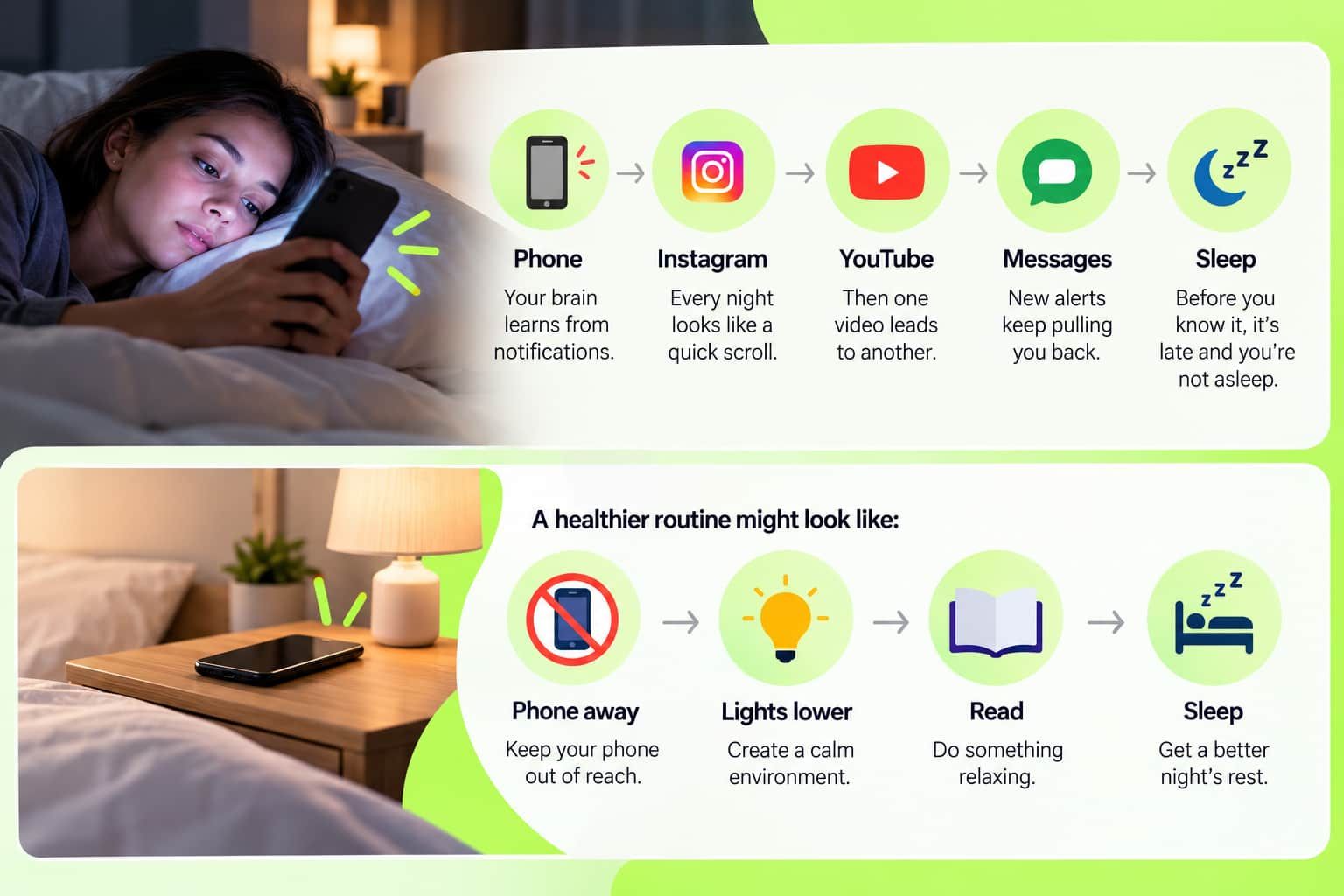
Your brain learns from routines.
If every night looks like:
Bed → Phone → Instagram → YouTube → Messages → Sleep
then getting into bed may start feeling like phone time instead of sleep time.
A healthier routine might look like:
Phone away → Lights lower → Read → Relax → Sleep
This matters because good sleep routines depend partly on making bedtime predictable.
- Going to bed and waking at similar times each day
- Keeping the bedroom quiet and relaxing
- Turning off electronic devices at least 30 minutes before bedtime
- Avoiding caffeine later in the day
- Exercising regularly
Useful Features for This Problem
Screen-time tools can support the routine through features such as:
The important part is making the better behavior easier.
6. Is Phone Radiation Dangerous While You Sleep?
This is one of the biggest worries people have.
You may have heard claims that keeping a phone next to you while sleeping exposes your brain to dangerous radiation or causes cancer.
Current evidence does not support saying that sleeping near a normal mobile phone causes cancer.
Phones use radiofrequency radiation, which is a form of non-ionizing radiation. It does not have enough energy to damage DNA in the same way as ionizing radiation such as X-rays.
WHO says the evidence to date suggests that cell-phone use does not cause brain cancer or other cancers in humans.
The FDA similarly states that the weight of scientific evidence has not linked radiofrequency radiation from cell phones with health problems.
What Should You Actually Worry About?
| Concern | What Evidence Suggests |
|---|
| Phone causes cancer because it is near your pillow | Current evidence does not establish this |
| Blue light may affect sleep | Possible, especially with nighttime use |
| Notifications may disturb sleep | Yes |
| Scrolling may delay bedtime | Yes |
| Phone use during the night may reduce sleep quality | Research shows an association |
| Charging under a pillow can trap heat | Yes, avoid it |
For sleep, your behavior around the phone is a much clearer concern than radiofrequency exposure.
7. Do Not Charge Your Phone Under Your Pillow
This is different from the radiation question.
A charging phone creates heat.
If it is placed under:
- A pillow
- A blanket
- Your body
- Thick bedding
that heat may not escape properly.
Apple's official safety guidance says not to sleep on a charging phone, charger, or wireless charger and not to place them under a pillow, blanket, or your body. The company recommends keeping charging equipment in a well-ventilated area.
So if you keep your phone near bed at night, charge it on a hard, open surface rather than inside the bed.
Safer Charging Habits
- Use a proper charger.
- Replace damaged cables.
- Keep the phone uncovered.
- Do not charge under your pillow.
- Do not sleep on the charging cable.
- Keep the charger somewhere with airflow.
This is a practical safety issue, not something to panic about.
8. How Far Should Your Phone Be From Your Bed?
There is no scientifically proven magic distance such as "three feet" that guarantees better sleep.
For most people, the better question is:
How far away does my phone need to be so I stop checking it?
That may be:
- On a desk across the room
- On a dresser
- Outside the bedroom
- Somewhere you have to stand up to reach
If you use your phone as an alarm, putting it across the room may actually help.
You still hear the alarm, but you cannot casually check Instagram from your pillow.
| If You Need Your Phone For... | Try This |
|---|
| Alarm | Put it across the room |
| Emergency calls | Use Do Not Disturb with selected contacts allowed |
| Work availability | Set a clear emergency contact rule |
| Sleep sounds | Start audio, then lock the phone and place it away |
| Charging | Use a bedside table or desk with good airflow |
The goal is not distance for the sake of distance.
The goal is reducing temptation.
9. How to Stop Using Your Phone Before Bed
Trying to suddenly go from two hours of bedtime scrolling to zero may feel difficult.
Start gradually.
Try This 7-Step Routine
- Choose a fixed bedtime.
- Stop social media 30 to 60 minutes before bed.
- Turn off unnecessary notifications.
- Set App Limits for your biggest evening distractions.
- Automatically start Sleep Mode each night.
- Put the phone away from your pillow.
- Replace scrolling with something simple.
Your replacement could be:
- Reading
- Stretching
- Journaling
- Calm music
- Meditation
- Preparing clothes for tomorrow
- Writing tomorrow's task list
| Instead of This | Try This |
|---|
| TikTok in bed | Read 5 pages |
| Checking email | Write tomorrow's priorities |
| Instagram scrolling | Listen to calm audio |
| Watching random videos | Stretch for 10 minutes |
| Checking notifications | Use Do Not Disturb |
You are not only removing your phone.
You are building a new bedtime habit.
What If You Need Your Phone Beside You?
That is completely understandable.
Some people need their phone nearby because of:
- Children
- Elderly parents
- Emergency calls
- Work responsibilities
- Medical reasons
- Alarm clocks
You can still reduce the sleep disruption.
Try:
- Allowing calls only from important contacts
- Blocking entertainment apps after bedtime
- Turning the screen face down
- Keeping the phone beyond arm's reach
- Using a scheduled Sleep Mode
- Removing vibration for non-essential apps
You do not need to choose between being reachable and sleeping well.
You need better boundaries.
Are you Still Sleeping With Your Phone Beside You? Here’s How Jolt Can Help
Knowing that late-night phone use can affect sleep is one thing. Actually putting the phone down every night is another.
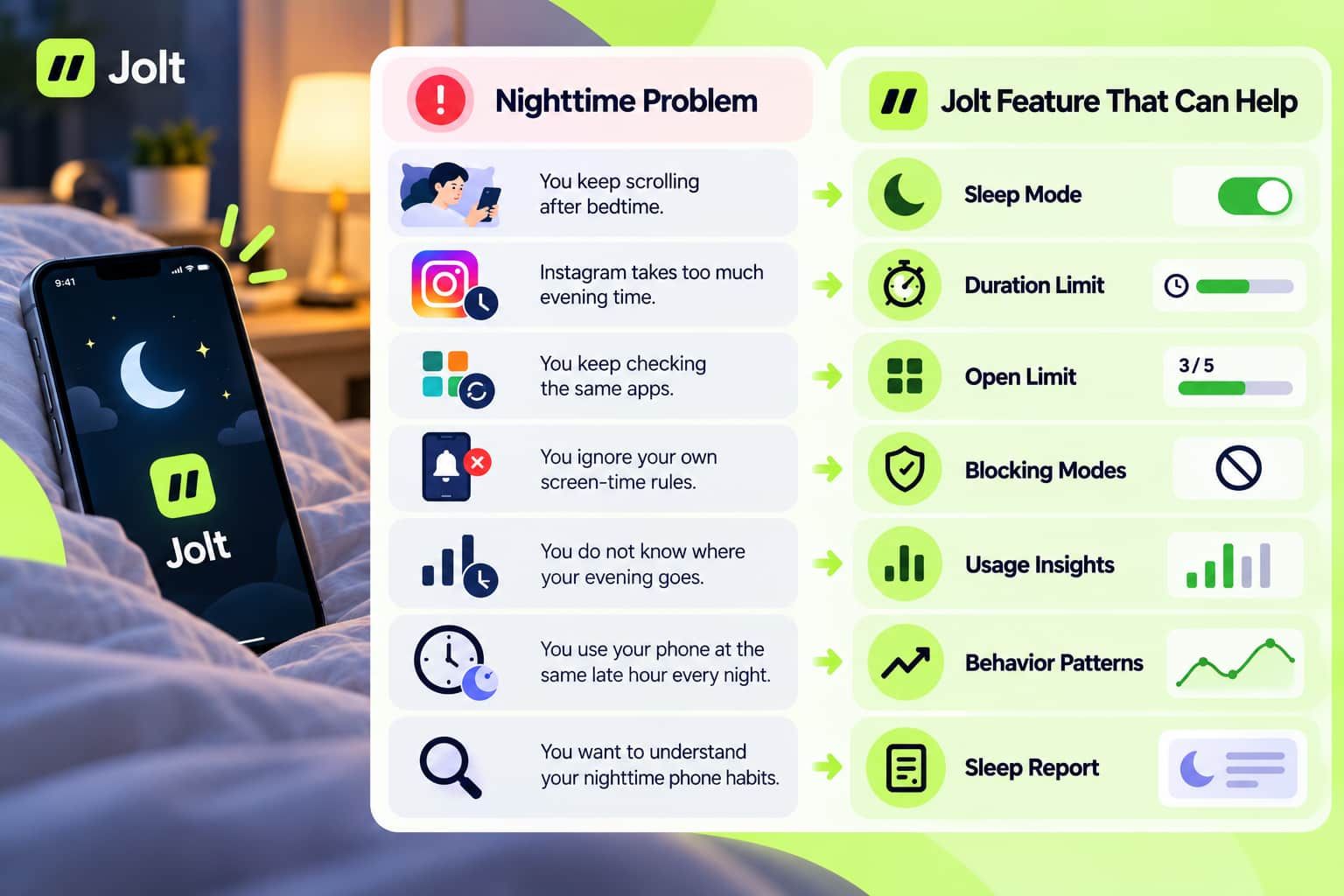
Jolt helps make that change easier by creating clear limits around your nighttime phone habits. Instead of depending on willpower when you are tired, you can set the rules earlier and let them work automatically.
How Jolt Can Make Your Bedtime More Phone-Free
- Sleep Mode can automatically restrict selected apps around your bedtime.
- App Limits can reduce how much time you spend on social media or entertainment apps during the day and evening.
- Open Limits can stop you from checking the same app again and again before sleep.
- Blocking Modes can make nighttime restrictions harder to ignore or bypass.
- Usage Insights can show which apps take most of your evening screen time.
- Behavior Patterns can help you see when your phone use normally increases.
- Sleep Reports can show your last phone pickup before sleep, first pickup after waking, and overnight phone activity.
A Simple Example
Suppose your bedtime is 11:00 PM.
You could create a routine like this:
- 10:30 PM: Wind-down reminder
- 11:00 PM: Instagram, YouTube, Reddit, and other distracting apps become restricted
- Overnight: Sleep Mode stays active
- Morning: Review your Sleep Report and see when you last used your phone
The aim is not to make your phone unavailable when you genuinely need it.
It is to make mindless bedtime scrolling less convenient.
That small change can make it easier to stop treating your bed like another place to scroll and start treating it as a place to sleep.
Conclusion
So, is it bad to sleep with your phone next to you?
Simply having a phone on a table beside your bed is not proven to be dangerous. The bigger problem is that easy access can encourage scrolling, late-night messages, repeated checking, and interrupted sleep. Charging a phone under your pillow or bedding should also be avoided because heat needs somewhere to escape.
A healthier goal is simple: make your phone less available when your body is supposed to sleep.
Frequently Asked Questions
1. Is it bad to sleep with your phone next to you every night?
Having a phone nearby is not automatically harmful. The main concern is that easy access may encourage nighttime scrolling, notifications, and repeated checking, which can interfere with sleep.
2. How far away should your phone be while sleeping?
There is no proven perfect distance for better sleep. A practical option is to keep your phone far enough away that you cannot reach it without getting out of bed.
3. Does sleeping next to your phone expose you to dangerous radiation?
Cell phones emit non-ionizing radiofrequency radiation. Current evidence from organizations including the National Cancer Institute and FDA has not established that normal cell-phone use causes cancer in humans.
4. Is it safe to charge your phone next to your bed at night?
Charging on an open bedside table is different from charging under bedding. Do not put a charging phone, adapter, or wireless charger underneath your pillow, blanket, or body because trapped heat can create a safety risk.
5. Does using a smartphone before bed affect sleep?
Associations between nighttime smartphone use and poorer sleep outcomes, including longer time to fall asleep and poorer sleep quality. However, factors such as what you are doing on the phone, how long you use it, and when you stop also matter.

 Download Now
 Take charge of your time