How a Screen Time App Can Save Relationships Between Couples
It is common for
couples to sit together and still feel alone nowadays. One partner is scrolling through social media, the other is watching a video, and both phones are lit up between them.
This kind of “phubbing” (phone snubbing) slowly eats away at connection, trust, and even basic conversations.
Institue For Family Study found that phone use around a partner is strongly linked to lower relationship quality and lower overall happiness, especially for women.
A
screen time app can reverse this trend. Far from being just a “productivity” tool, a good screen time app becomes a relationship‑saving device. It helps couples create real, device‑free moments, rebuild eye contact, and protect the small conversations that hold love together.
Why phones hurt couples even when no one is fighting
Many couples do not think they have a “phone problem.” They assume that as long as they are not arguing, everything is fine. But the damage comes from what is missing, not what is shouted.
A study published in the
Medical News Today showed that even small phone interruptions during daily conversations reduce emotional closeness and make partners feel less valued.
Another survey by
CNE News found that 70% of couples say they have had conflicts because of screen time, and
62% of Irish adults believe mobile‑phone use hurts their relationships.
These numbers tell an important story: your phone does not need to be the main reason for a big fight for it to ruin your connection quietly over time. Each time you pick up your phone instead of your partner’s hand, you train your brain to choose the screen over the person.
How a screen time app protects couple time
A screen time app is not just a tool to track minutes. It is a smart, automatic helper that guards your relationship. An
app to limit screen time can do several things at once:
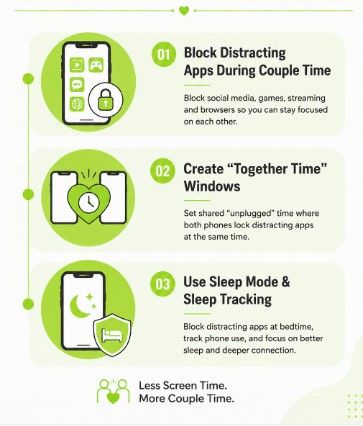
Block distracting apps during couple time
A good screen time control app lets you select which apps to block social media, games, streaming, and even browsers during certain hours. This means no “just one more video” or “one quick scroll” when you are sitting together for dinner, watching a movie, or talking in bed. Instead, the app to limit screen time makes it harder to go online and keeps the focus on your partner.
Create “Together Time” windows
Some advanced screen time apps let couples set shared “unplugged” blocks where both phones lock the same apps at the same time.
For example, a couple can schedule a daily 90‑minute window right after work when all social apps and games are blocked.
During this time, phones can only be used for calls, messages, or navigation. This creates a predictable rhythm of presence that brains and hearts can learn to rely on.
Use sleep‑mode and sleep‑tracking features for bedtime
Nighttime is one of the most important relationship windows. Yet many couples end the day lying side by side, each scrolling instead of talking.
A screen time unlock app can help by turning on
Sleep Mode at a set bedtime. It blocks distracting apps and websites, shows you how many times you picked up the phone, and gently pushes you to put the device away so you can actually talk, cuddle, or just breathe together in silence.
How couples can use a screen time control app step by step
A screen time app works best when both partners agree to use it as a shared rule, not as a punishment. Here is how a couple can start slowly and seriously:
Define your “no‑phone zones”
Decide together on a few fixed times each day when phones are not welcome:
- First 30 minutes after coming home
- Dinner table
- Bedtime for 30 minutes
A screen time control app can then block specific apps automatically during these hours.
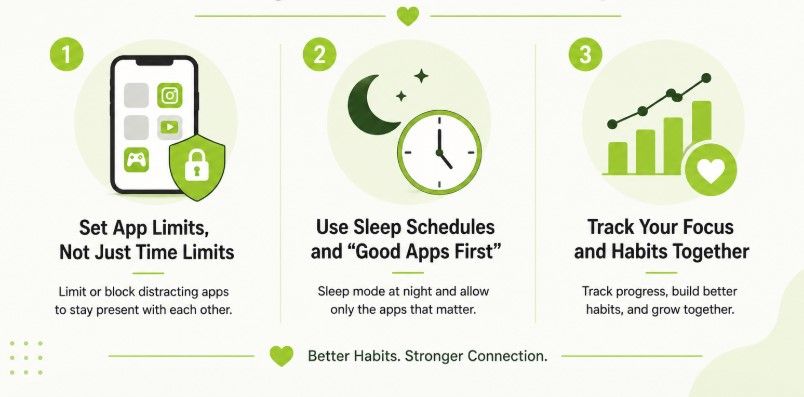
Set app limits, not just time limits
Instead of just saying “less screen time,” be specific. For example:
- Social media: maximum 30 minutes per day
- Video apps: maximum 1 episode per evening when alone
A strong app to limit screen time can enforce these limits so you stop only when you reach the cap, not when you feel like it.
Use sleep schedules and “Good Apps First”
Some apps let you set a bedtime and choose which apps are allowed before sleep, such as journaling, reading, or meditation apps.
This helps you move away from endless video or social‑media scrolling and towards calmer, more meaningful routines that support better sleep and better conversations.
Track your focus and habits together
Many screen time apps give you a “Focus Score” or habit report. Couples can check these reports weekly and talk about how they feel.
- Do you sleep better?
- Do you talk more?
- Do arguments about phones feel rarer?
This kind of data‑driven conversation turns a tech tool into a joint relationship project.
Why couples who use these apps feel closer
When couples start using a screen time app intentionally, many notice the same pattern: small moments become meaningful again.
Eye contact returns. Laughter happens without a notification in the middle.
We have experimented it with one of our team member. She and her partner started using the app to block and limit the screen time, and ended their day with real conversations instead of parallel scrolling.
Another study on
Verwell Mind found that couples who had similar rules about phone use felt more connected and less resentful. It was not about how much time they spent online, but about shared norms and mutual respect. A screen time app makes it easier to build those shared norms, because the rules are written in the phone itself, not just in whispered promises.
Conclusion
Relationship in 2026 is not just about gifts, trips, or deep talks. It is also about how you choose to spend your attention.
Every minute you spend on a screen is a minute you do not spend looking at, listening to, or touching your partner.
A smart screen time unlock app can help you guard those minutes.
For couples who want to stop drifting apart while sitting side by side, integrating tools like this into daily life can be the first honest step toward reconnection.
When the right moment eventually comes for a powerful, long‑term solution, a focused, modern app such as
Jolt app can give you the structure you need to finally reclaim your time
Frequently Asked Questions:
- How exactly does a screen time app reduce phone distraction between couples?
A screen time app sets automatic blocks and limits on distracting apps during couple time, so phones cannot interrupt conversations, meals, or evenings together.
- Can a screen time control app really improve relationship quality over time?
Yes, research shows that reducing phone use around partners directly raises relationship satisfaction and emotional closeness when stable, shared rules are enforced.
- What is the difference between a screen time app and a simple “digital wellbeing” dashboard?
A true screen time app focuses on behaviour change, automated blocks, scheduled unplugged windows, and habit‑tracking, while basic dashboards only show usage without enforcing limits.
- How can couples use an app to limit screen time without feeling controlled?
Couples should jointly define “no‑phone zones,” choose app limits together, and use the app as a shared agreement, not as surveillance or punishment.
- Is a screen time unlock app only useful for heavy social‑media users?
No, it also helps people with hidden scrolling habits, night‑time phone use, or “innocent” video‑browsing that silently erodes couple connection and sleep‑time conversations.

 Download Now
 Take charge of your time