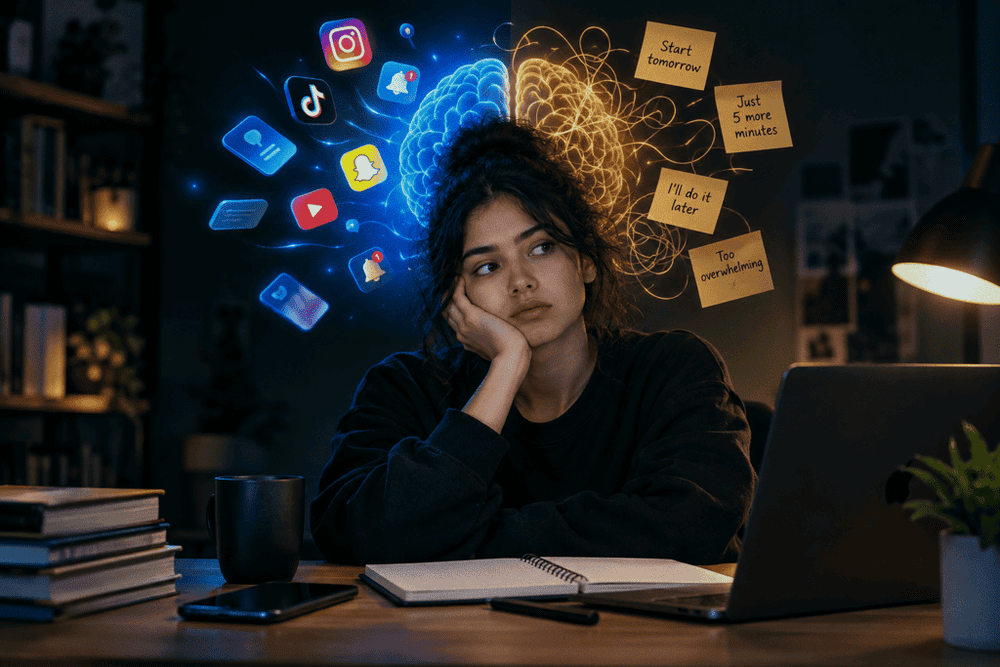
Why Do You Wake Up Tired After 8 Hours of Sleep?
You went to bed on time. You slept for eight hours. The alarm rings, but instead of feeling fresh, you still want to pull the blanket over your head.
It can be confusing. You may wonder, “Why do I wake up tired after 8 hours of sleep?”
The simple answer is that sleep time and
sleep quality are not the same thing. You may spend eight hours in bed but still have broken, light, badly timed, or restless sleep.
Here are the most common reasons you may still wake up tired.
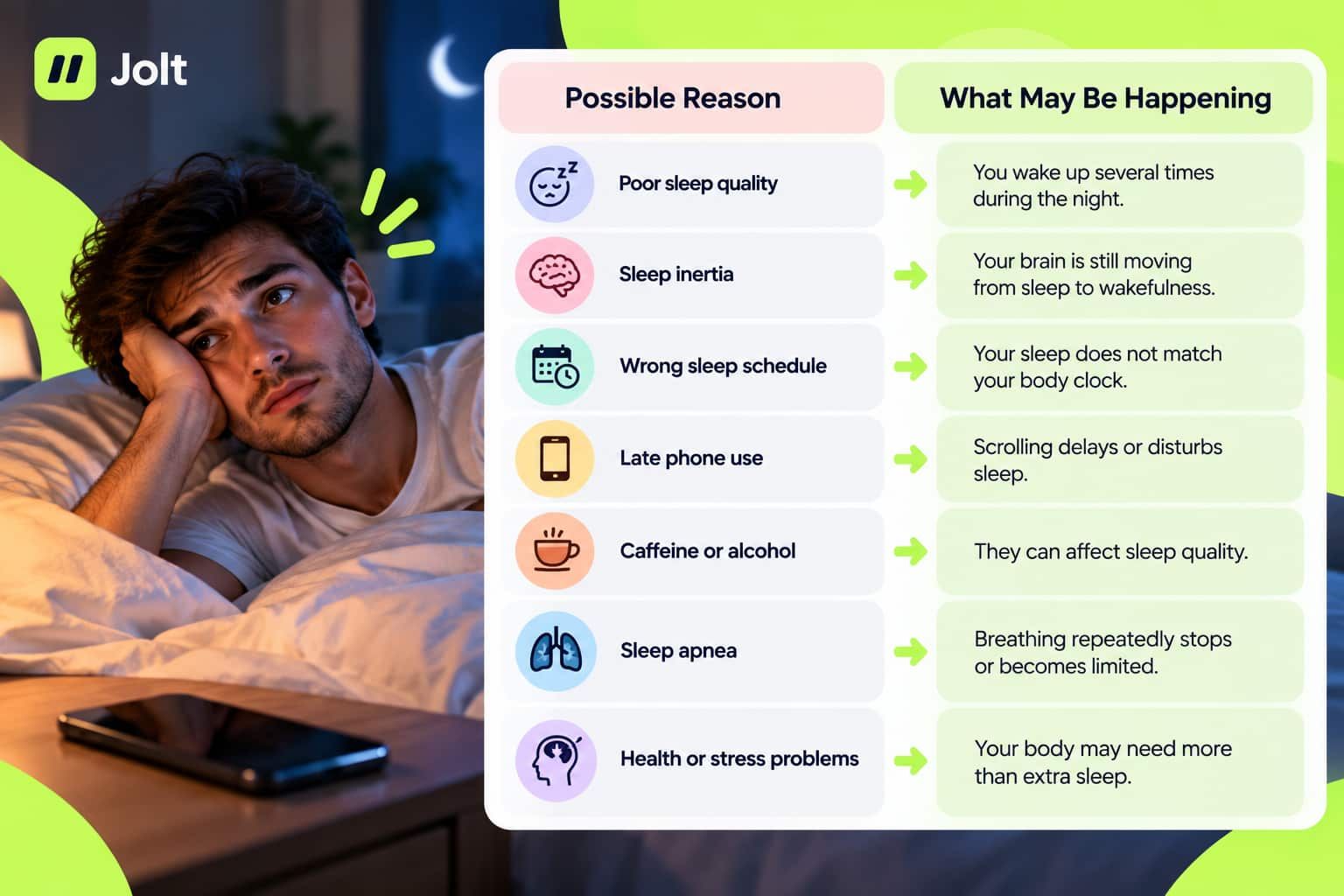
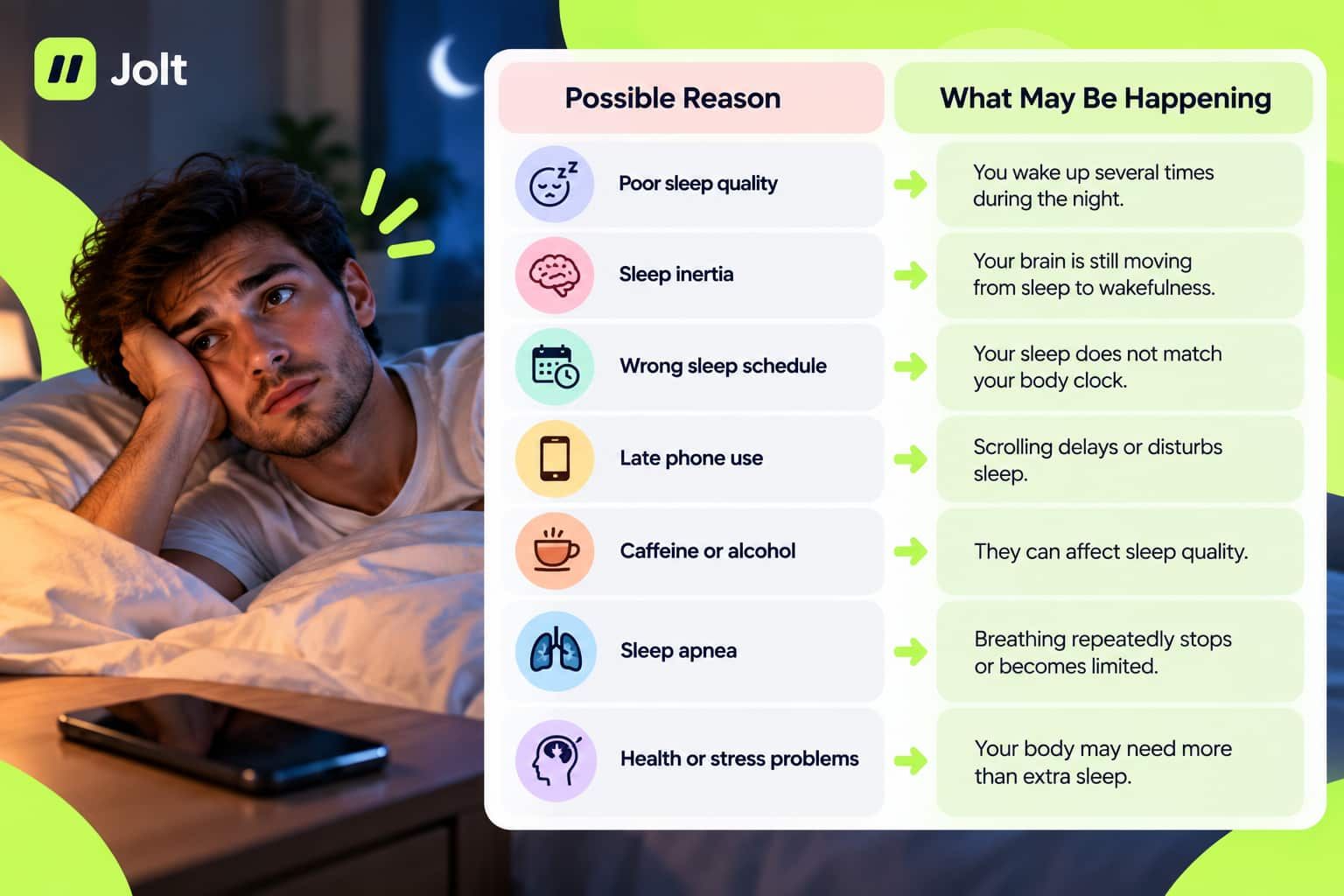
Why Am I Still Tired After 8 Hours of Sleep?
Start with this quick overview.
Let us look at each reason more closely.
1. You Slept for 8 Hours, but the Sleep Was Not Restful
Eight hours on the clock does not always mean eight hours of good sleep.
You may wake briefly many times without remembering it the next morning. Noise, temperature, stress, pets, notifications, pain, or breathing problems can all disturb sleep.
Good sleep needs to be reasonably continuous.
Signs that your sleep quality may be poor include:
- Waking several times at night
- Tossing and turning
- Waking with a headache
- Feeling sleepy during the day
- Struggling to focus
- Feeling as if you could sleep again immediately
The
Healthline says sleep deficiency can leave you feeling tired during the day and not refreshed or alert when you wake up, even when you have spent enough time in bed.
So when asking, “Why do I wake up tired after 8 hours of sleep?”, look at quality before simply adding more hours.
2. You May Be Experiencing Sleep Inertia
Sometimes there is nothing seriously wrong with your sleep.
Your brain may simply need time to wake up.
This feeling is called sleep inertia.
Sleep inertia can make you feel:
- Groggy
- Slow
- Confused
- Heavy
- Unmotivated
- Tempted to go straight back to sleep
CDC describes sleep inertia as temporary sleepiness and reduced mental performance immediately after waking. The strongest effects often occur during the first 30 minutes, although the experience can vary.
Even a normal eight-hour night's sleep can be followed by sleep inertia, especially if your alarm wakes you from deeper sleep.
Give yourself a little time before deciding that your whole night's sleep was poor.
3. Your Body Clock May Be Out of Sync
Your body has an internal clock called the circadian rhythm.
It helps decide when you naturally feel sleepy and when you feel alert.
You may sleep eight hours but still feel terrible if those hours do not match your natural sleep-wake rhythm.
This can happen when you:
- Sleep very late on weekends
- Wake at different times every day
- Work night shifts
- Travel between time zones
- Stay awake late and wake early during weekdays
- Have an irregular work schedule
The
Harvard health explains that when your sleep-wake cycle becomes out of sync with your environment, sleep quality may become poor and daytime tiredness can follow.
A regular sleep schedule often matters as much as the number of hours.
4. Your Phone May Be Affecting Your Sleep More Than You Think
You may technically sleep from midnight to 8 AM.
But what happened before midnight?
Were you scrolling in bed?
A 2024 systematic review and meta-analysis covered 55 studies and 41,716 participants. It found that electronic media use was associated with poorer sleep quality and more sleep problems. Smartphone use showed one of the stronger relationships among the types of general media use studied.
Another meta-analysis covering 17 studies and more than 36,000 participants found that heavier smartphone use was associated with poorer self-reported sleep quality.
Late phone use may affect sleep because it can:
- Push bedtime later
- Keep your brain mentally active
- Encourage endless scrolling
- Bring work and social stress into bed
- Create notification disturbances
A
Sleep Report can also help you see your last phone pickup before bed and your first pickup after waking.
5. Your Afternoon Coffee May Still Be Working at Bedtime
That 4 PM coffee may feel harmless.
Your sleep may disagree.
The
NIH notes that caffeine is a stimulant and its effects can last for up to eight hours. Late-afternoon coffee can therefore make it harder to fall asleep properly at night.
Alcohol can also be misleading.
It may make you feel sleepy at first, but alcohol can break up sleep later in the night. The National Institute on Alcohol Abuse and Alcoholism explains that alcohol can produce more fragmented sleep and earlier waking.
| Habit | Better Choice |
|---|
| Coffee late afternoon | Move caffeine earlier |
| Alcohol before sleep | Avoid using alcohol as a sleep aid |
| Heavy meal before bed | Eat earlier |
| Scrolling until sleep | Create a wind-down period |
6. Sleep Apnea Could Be Disturbing Your Sleep
If tiredness happens almost every morning, especially with loud snoring, sleep apnea is worth discussing with a healthcare professional.
Sleep apnea causes breathing to repeatedly stop and restart during sleep.
Common signs include:
- Loud snoring
- Gasping during sleep
- Breathing that stops and starts
- Morning headaches
- Dry mouth
- Daytime tiredness
- Difficulty concentrating
Sleep apnea can prevent restful sleep and may cause daytime sleepiness and fatigue.
You might sleep eight hours but still have your sleep repeatedly disturbed by breathing problems.
7. The Problem May Not Be Sleep Alone
Sometimes tiredness has another cause.
Possible factors can include:
- Stress
- Anxiety
- Low mood
- Certain medicines
- Iron deficiency or anemia
- Thyroid problems
- Other health conditions
This does not mean morning tiredness automatically points to a medical condition.
But if you regularly sleep eight or more hours and still never feel rested, it is worth paying attention.
Talking with a doctor if you sleep more than eight hours but regularly do not feel well rested, because a sleep disorder or another health issue may be involved.
How Can You Wake Up Feeling More Refreshed?
Do not only focus on sleeping longer.
Work on making sleep more regular and less interrupted.
Try these simple habits:
- Go to bed at roughly the same time each night.
- Wake at roughly the same time every morning.
- Keep your bedroom dark, quiet, and cool.
- Reduce bright screens before sleep.
- Move caffeine earlier in the day.
- Avoid alcohol as a way to fall asleep.
- Get natural daylight during the day.
- Exercise regularly.
- Keep distracting apps away from bedtime.
- Track whether nighttime phone use is improving.
Keeping regular sleep times, having quiet time before bed, reducing bright artificial light, staying physically active, and keeping the bedroom cool, dark, and quiet.
Are You Still Waking Up Tired? Jolt Can Help Fix the Phone Habits Behind Your Poor Sleep
Getting eight hours of sleep may not help much if your phone keeps delaying bedtime, waking you during the night, or pulling you back into scrolling.
Jolt helps you create stronger boundaries around nighttime phone use. Instead of depending on willpower when you are already tired, you can set limits in advance and let them work automatically.
How Jolt Can Help You Build a Better Night Routine
- Sleep Mode can restrict distracting apps automatically around your bedtime.
- Wind-Down Reminders can tell you when it is time to move away from your phone and prepare for sleep.
- App Limits can control how much time you spend on social media, videos, and entertainment apps.
- Open Limits can reduce the habit of checking the same apps again and again at night.
- Blocking Modes can make nighttime restrictions harder to ignore when you are tempted to keep scrolling.
- Sleep Reports can show your last phone pickup before sleep, your first pickup after waking, and overnight phone activity.
- Usage Insights can help you find the apps taking up most of your evening.
- Behavior Patterns can reveal the times when your phone use usually starts increasing.
What a Better Night Could Look Like
Suppose you want to sleep at 11:00 PM.
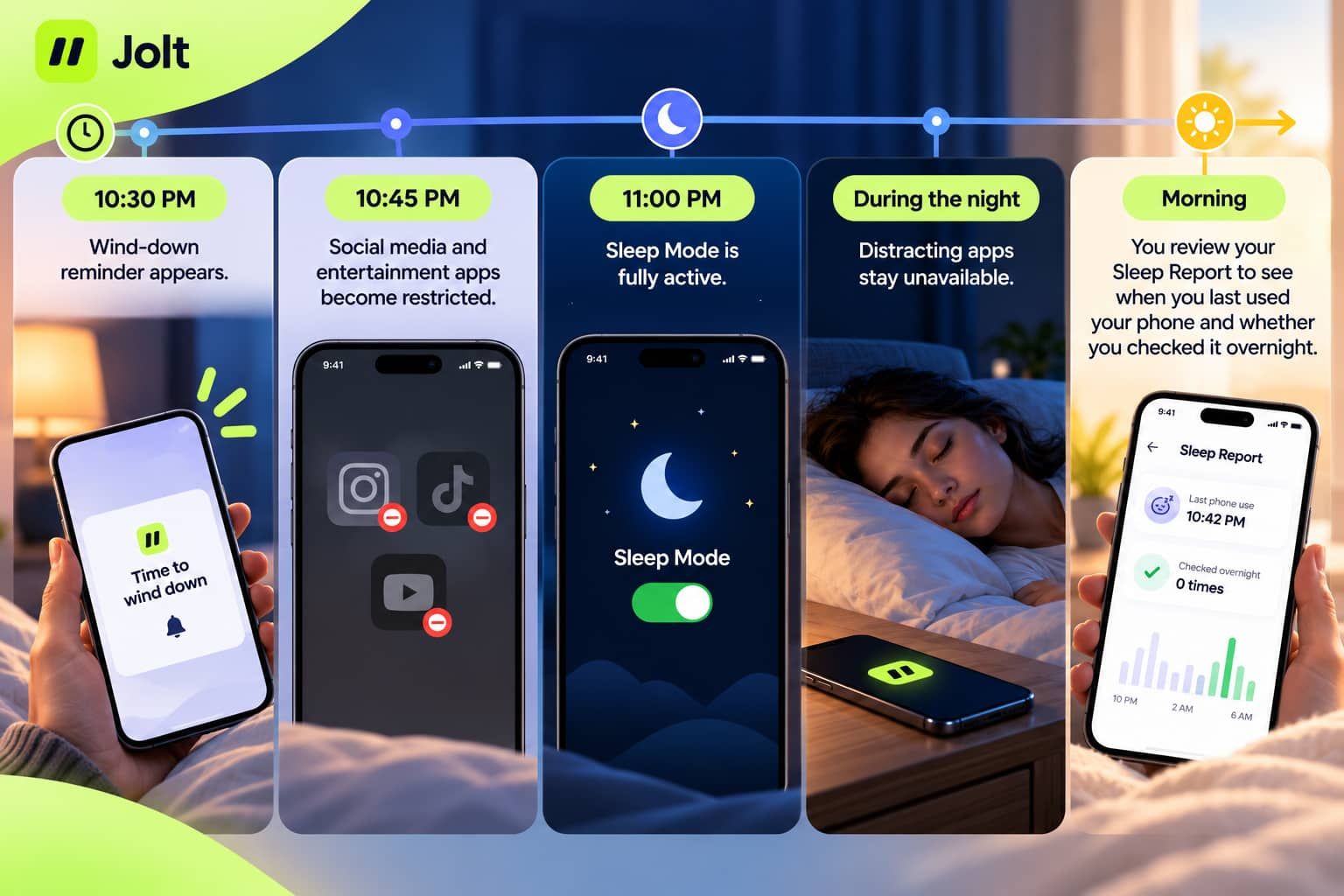
Your routine could look like this:
- 10:30 PM: Wind-down reminder appears.
- 10:45 PM: Social media and entertainment apps become restricted.
- 11:00 PM: Sleep Mode is fully active.
- During the night: Distracting apps stay unavailable.
- Morning: You review your Sleep Report to see when you last used your phone and whether you checked it overnight.
The goal is not simply to sleep for eight hours.
The goal is to make those eight hours more peaceful, more regular, and less affected by late-night phone habits.
Conclusion
So, why do I wake up tired after 8 hours of sleep?
Because eight hours is only one part of healthy sleep. Your sleep may be interrupted, poorly timed, affected by late caffeine, disturbed by a sleep condition, or weakened by nighttime phone habits.
Start by looking at what happens before and during those eight hours.
If your phone is one of the reasons your bedtime keeps slipping,
Jolt can help through Sleep Mode, Sleep Reports, App Limits, Open Limits, Blocking Modes, and Usage Insights. These tools can create stronger nighttime boundaries and show whether your phone habits are actually becoming healthier.
If tiredness continues despite a regular routine and enough sleep, especially if you snore loudly, gasp during sleep, or feel very sleepy during the day, speak with a healthcare professional.
Frequently Asked Questions
Is 8 hours of sleep enough?
For many adults, yes. Most adults generally need around 7 to 9 hours, but individual sleep needs differ. Sleep quality and timing also matter.
Why do I sleep 8 hours but still want more sleep?
Poor sleep quality, sleep inertia, an irregular sleep schedule, stress, late caffeine, nighttime phone use, or a sleep disorder may all contribute.
Why am I tired in the morning but fine later?
You may be experiencing sleep inertia. Grogginess immediately after waking can improve as your brain moves fully into wakefulness.
Can too much phone use make me wake up tired?
It may contribute. Research has found associations between heavier electronic media or smartphone use and poorer sleep quality.
When should I worry about waking up tired?
Consider speaking with a healthcare professional if it happens regularly despite enough sleep, or if you also experience loud snoring, gasping, morning headaches, severe daytime sleepiness, or difficulty functioning.

 Download Now
 Take charge of your time