How AI Usage Is Increasing Our Screen Time & Is It a Good Thing or Not?
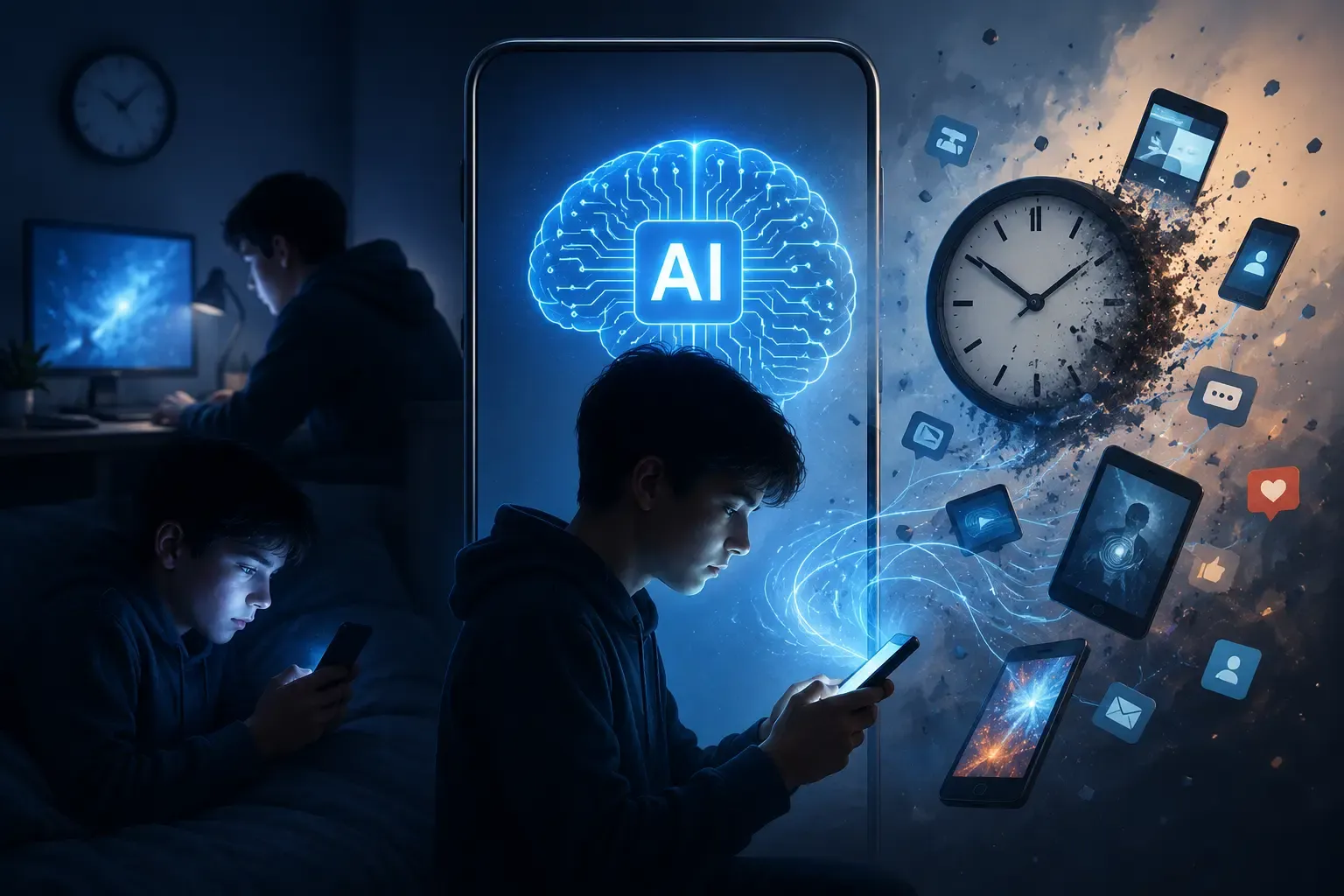
Artificial Intelligence (AI) is now part of daily life. People use AI for search, writing, learning, chatting, and even emotional support. Because of this, AI usage is directly increasing our screen time.
This raises an important question:
Is AI usage good or not, especially when it increases screen time?
Let us break this down in a simple and clear way.
Check out the Jolt app
What Is AI Screen Time?
AI screen time means the total time we spend using tools powered by Artificial Intelligence. This type of screen use is different from traditional screen time because it involves active interaction and real-time responses.
This includes:
- Chatbots for answering questions and conversations
- AI search tools that give direct answers
- AI-generated content platforms
- Recommendation systems that suggest videos and posts
Earlier, screen time was mostly passive, where users only watched or scrolled. Now, AI has made it interactive and engaging.
People are not just consuming content anymore. They are:
- Asking questions repeatedly
- Creating content using AI
- Learning concepts step by step
- Having conversations with AI systems
This shift has increased both the quality and quantity of screen time significantly.
How AI Usage Is Increasing Our Screen Time
AI is increasing screen time in multiple ways, and these changes are subtle but powerful.
1. AI Makes Content Endless
AI algorithms suggest content based on your behavior and interest.
- You watch one video
- AI suggests more related videos
- You keep watching without noticing time
This creates a continuous loop of engagement. Studies show that
AI-driven recommendations increase user engagement and session time significantly.
Because of this, users often spend more time than planned, especially on short-form content platforms.
2. AI Is Now Used for Daily Tasks
AI is no longer optional. It is becoming part of everyday work and study.
People now use AI for:
- Writing emails and documents
- Completing assignments
- Searching for quick answers
- Solving complex problems
This increases screen time because tasks that were once offline are now done digitally.
Even small tasks like planning or note-making are now done using AI tools.
This shift has made screens a constant part of daily productivity.
3. AI Is Becoming a Digital Companion
Many users now interact with AI for personal reasons, not just work.
They use AI for:
- Advice and guidance
- Emotional support
- Casual conversations
- Daily planning
This increases screen time because users return again and again to interact.
The phone or laptop becomes more than a device. It becomes a companion.
4. AI Encourages Continuous Interaction
AI systems respond instantly. This creates a strong engagement loop.
- You ask one question
- You get a clear answer
- You ask another question
- The conversation continues
This pattern keeps users engaged for longer periods.
Unlike traditional content, AI adapts to your needs in real time.
This leads to longer sessions and increased screen time without clear limits.
Check out the Jolt app The Positive Side: Is AI Usage Good?
AI usage has many benefits when used in a structured way.
1. Improves Learning Speed
Students can learn faster using AI.
- They get instant explanations
- They understand difficult topics quickly
- They can practice more efficiently
This improves learning outcomes and saves time in studying.
2. Saves Time in Work
AI helps complete tasks faster.
This improves productivity and reduces workload.
Even though screen time increases, the output also improves.
3. Supports Mental Health
AI tools can provide:
- Guided support
- Simple advice
- Stress management tips
Some users feel comfortable sharing thoughts with AI.
This creates a sense of support, especially for those who feel alone.
4. Makes Information Easy to Access
AI reduces effort in searching for information.
Instead of reading multiple sources, users get direct answers.
This improves efficiency and saves time.
AI makes learning and problem-solving faster and simpler.
The Negative Side: Is AI Usage Good or Not?
Despite the benefits, AI usage also brings challenges.
1. Increased Screen Dependency
More AI usage means more time on screens.
Studies show that excessive screen time is linked with poor well-being and mental fatigue.
This creates dependency on digital tools.
2. Reduced Attention Span
AI gives instant answers.
This reduces the need for deep thinking.
Over time, users may lose patience and struggle with long tasks.
This weakens attention and focus.
3. Emotional Dependence on AI
Some users rely heavily on AI for support.
This can reduce real-life communication.
It may also affect emotional balance if not controlled properly.
4. Overuse Without Awareness
AI usage often feels productive.
Even when not needed, users stay on screen.
This creates hidden overuse.
The problem is not always visible but builds over time.
AI Screen Time Impact Matrix
| Area | Positive Impact | Negative Impact |
|---|
| Learning | Faster understanding | Less deep thinking |
| Work | Higher productivity | More screen hours |
| Mental Health | Support and guidance | Emotional dependency |
| Attention | Focus tools available | Reduced attention span |
| Habits | Structured usage possible | Addiction risk |
This matrix shows that AI usage has both benefits and risks.
The outcome depends on how it is used in daily life.
The Role of Digital Wellness
Digital wellness means using technology in a balanced and healthy way.
It focuses on:
- Awareness of usage
- Control over habits
- Structured routines
- Healthy breaks
This idea becomes very important when AI usage increases.
How to Use AI Without Increasing Harmful Screen Time
To manage AI screen time, follow simple and practical habits:
- Use AI with a clear purpose
- Set fixed time limits
- Avoid unnecessary interaction
- Take regular breaks
- Focus on learning and productivity
These habits help maintain control and prevent overuse.
They also improve focus and reduce mental fatigue.
Check out the Jolt app Conclusion
AI usage is clearly increasing our screen time. It is becoming part of daily life in learning, work, and communication.
The answer to “Is AI usage good or not?” depends on how it is used.
AI is helpful when it improves productivity, learning, and efficiency. It becomes harmful when it increases dependency and reduces focus.
The key is balance. With the right habits and awareness, AI can be a powerful tool instead of a distraction.
This is where
Jolt a screen time app help by giving users control over screen habits, setting limits, and supporting better digital routines.
In the end, AI is not the problem. The way we use it decides the impact on our life.
Frequently Asked Questions
-
Why is AI usage increasing our screen time so quickly?
AI tools are designed to be fast, helpful, and engaging. People use them for learning, work, and even casual conversations. Because AI gives instant answers and continuous interaction, users tend to stay longer on screens. This is why AI screen time is growing faster than traditional screen usage.
-
Is AI screen time better than normal screen time?
AI screen time can be better if it is used for useful tasks like learning, problem-solving, or productivity. However, if it turns into continuous chatting or unnecessary usage, it becomes similar to normal screen addiction. The difference depends on how you use AI, not just the time spent.
-
Can AI usage affect focus and attention?
Yes, AI usage can affect focus in both positive and negative ways. It can improve focus when used for structured tasks like studying or planning. But if used without limits, it can reduce attention span because users get used to quick answers and constant interaction.
-
How can I control my AI screen time?
You can control AI screen time by setting clear goals before using it. Use AI only when needed and avoid long unnecessary sessions. Set time limits, take breaks, and track your usage. These simple habits help maintain balance and prevent overuse.
-
Is AI usage good or not in the long term?
AI usage is good when it supports learning, productivity, and problem-solving. It becomes harmful when it increases dependency and reduces real-life interaction or focus. In the long term, balanced and mindful usage is the best approach to get benefits without negative effects.

 Download Now
 Take charge of your time